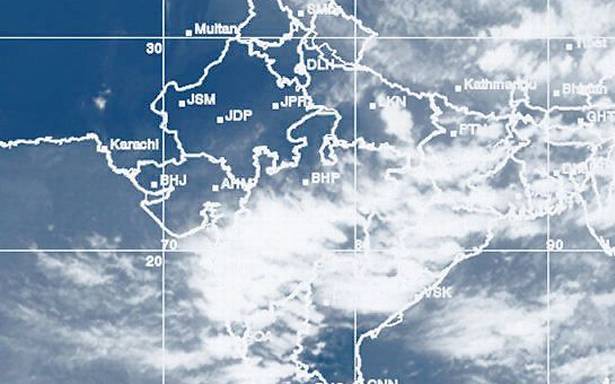
The city recorded 9.8 mm rainfall up to 5.30 pm on Thursday. Till 2.30 pm, it was 8 mm. Weather experts said that the rainfall is part of the southwest monsoon and also because of the formation of various systems.
The city also recorded a maximum temperature of 24.7 degrees Celsius, around four degrees below the normal 28 degrees, on Thursday afternoon.
The HAL airport received 14 mm rainfall while the international airport recorded 3.8 mm rainfall up to 5.30 pm on Thursday. However, the the Bruhat Bengaluru Mahanagara Palike (BBMP) control room did not receive any tree fall or waterlogging complaints. C P Patil,
India Meteorological Department Bengaluru director-in-charge, said that south interior Karnataka, coastal Karnataka, Tamil Nadu and Kerala will receive moderate to heavy rainfall measuring up to 6-7 cm over the next four-five days.
He said there is a circulation over Lakshwadeep and Maldives area of the east Arabian Sea. A low-pressure area is likely to form during the next 24 hours, which will become a depression in the next 36 hours and move in northwest direction and further intensify to form a cyclone.
It will then move towards the Oman coast. The IMD has also issued a warning for fishermen not to venture into the sea. An alert has been issued for Karnataka, Tamil Nadu and Kerala.
Congress part of break India forces, of which Pakistan is an important component: BJP

The BJP on Thursday alleged that the Congress, which failed to forge a mahagatbandhan (grand alliance) in the country, was appearing to form an international alliance with the break India forces of which ‘Pakistan’ is an important component.
The BJP also hit out at Delhi Chief Minister Arvind Kejriwal and Aam Aadmi Party (AAP) of allegedly receiving funds from anti-India forces and accused it of compromising the national security.
“A few political parties in the country are trying to form an international mahagathbandhan with the anti-India forces to break the country of which Pakistan is an important component,” BJP leader Sambit Patra told media at a press conference here.
He said that there seems to be a mahagatbandhan of break India forces, of which Congress is also included. “They are unable to form a mahagatbandhan at home and they are forming a mahagatbandhan at international platform with break India forces,” he alleged.
The BJP leader said: “We have seen how Punjab Minister Navjot Singh Sidhu hugged the Pakistan Army Chief. There are many people in Pakistan who want to see Rahul Gandhi as Prime Minister.”
Citing other references, the BJP leader said, “When (External Affairs Minister) Sushma Swaraj spoke about Pakistan at the United Nations (UN), then Congress instead of supporting it objected to it.”
The BJP leader said there has been a sting operation by an English channel Republic TV about the leaders dealing with the Khalistan Front forces. “These are anti-India forces and these anti-India forces have a political pattern.
“And these forces have been regrouping and they have become quiet active,” he said, adding that Shamsher Singh who heads the National Sikhs Youth Federation, Gurcharan Singh of the Dal Khalsa and Paramjit Pamma, who was a terrorist and was arrested in Poland.
Patra said that in the sting operation Shamsher Singh can be heard saying that the Khalistan movement which they are running in London is a “secessionist movement to break India”.
“In the video Shamsher is heard saying that ‘we want India to break up, we want naxals to be free, we want a dravidsitan to be created. We shall help them as our enemy is same. Our enemy is New Delhi’,” Patra said.
The BJP leader said that Shamsher also said that “Pakistan is an ally and it has not done any genocides against Sikhs. “Pakistan recognises Khalistan as a legitimate nation, it is a natural ally,” he said.
He said that in the video Paramjit Singh Pamma also claimed that in India minorities are not being treated properly.
“This is what Rahul Gandhi is doing. He is going to international forums and saying that there is no freedom in India, there is no peace, no employment, minorities not being treated properly. But in China there is everything,” he pointed out referring to Gandhi’s recent visit to the European countries where he interacted with people and attacked the government over several issues.
Attacking Kejriwal and AAP, Patra said, in the sting operation Gurcharan Singh exposes their nexus.
He alleged that Kejriwal for his “political ambitions” was playing with national security which is “unpardonable.”
IANS
On fuel price,Centre followed footsteps of K’taka govt : HDK
The Central government to reduce fuel price by Rs 2.50 per litre, Chief Minister H D Kumaraswamy on Thursday said that the Centre had only followed the footsteps of the Karnataka government.

The JD(S)-Congress coalition government led by Kumaraswamy had reduced the tax (sales tax on fuel) by Rs 2 per litre only a month ago.
“The Centre has finally provided some relief to the common man by reducing the fuel price,” said Kumaraswamy speaking to reporters here. He, however, ruled out any further price reduction by the state government citing that fuel prices had been reduced in the state only last month after the nation-wide bandh protesting against the fuel price hike.
Meanwhile, state BJP president B S Yeddyurappa has demanded that the State government should immediately reduce the sales tax on fuel by Rs 2.30 per litre.
PTI
Petrochemicals set to be largest driver of oil demand: IEA
Petrochemicals are set to account for more than a third of the growth in world oil demand to 2030, and almost half the growth to 2050, adding nearly seven million barrels of oil a day by then, the International Energy Agency (IEA) said on Friday.

This means oil demand growth is shifting to petrochemicals, away from motor fuels.
The rising use of plastics is poised to consume an additional 56 billion cubic metres (bcm) of natural gas by 2030, and 83 bcm by 2050.
Petrochemicals — components derived from oil and gas that are used in all sorts of daily products such as plastics, fertilisers, packaging, clothing, digital devices, medical equipment, detergents and tyres — are becoming the largest drivers of global oil demand, in front of cars, planes and trucks, according to a major study by the IEA.
To address these challenges, the IEA’s Future of Petrochemicals report outlines a clean technology scenario, which provides an alternative future in line with key UN Sustainable Development Goals, such as climate action, responsible consumption and life below water, among others.
The scenario provides an ambitious but achievable pathway to reduce the environmental impacts of petrochemicals: air pollutants from primary chemicals production decline by almost 90 per cent by 2050; direct CO2 emissions reduce by nearly 60 per cent; and water demand is nearly 30 per cent lower than in the base scenario.
It also emphasises waste management improvements to rapidly increase recycling, thereby laying the groundwork to more than halve cumulative, ocean-bound, plastic waste by 2050.
In the clean technology scenario, petrochemicals become the only growing segment of global oil demand.
Despite near-tripling in plastic waste collection by 2050, the limited availability of cost-effective substitutes for oil feedstock means that oil demand for petrochemicals remains resilient.
The IEA’s report was developed with input from governments, industry and other key stakeholders, and seeks to bring the sector the attention it deserves in the global energy policy debate.
It also provides ten key policy recommendations to build a more sustainable and efficient petrochemicals industry.
“Our economies are heavily dependent on petrochemicals, but the sector receives far less attention than it deserves,” IEA’s Executive Director Fatih Birol said.
“Petrochemicals are one of the key blind spots in the global energy debate, especially given the influence they will exert on future energy trends. In fact, our analysis shows they will have a greater influence on the future of oil demand than cars, trucks and aviation.”
Demand for plastics — the key driver for petrochemicals from an energy perspective — has outpaced all other bulk materials such as steel, aluminium, or cement, nearly doubling since 2000.
Advanced economies currently use up to 20 times more plastic and up to 10 times more fertiliser than developing economies on a per capita basis, underscoring the huge potential for global growth.
The dynamism of the petrochemical industry is also driving new trends around the world.
After decades of stagnation and decline, the US has re-emerged as a low-cost location for chemicals production thanks to the shale gas revolution, and is now home to around 40 per cent of the global ethane-based petrochemical production capacity.
The Middle East remains the lowest cost centre for many key petrochemicals, with a host of new projects announced across the region.
Petrochemical products provide substantial benefits to society, including a growing number of applications in various cutting-edge, clean technologies critical to sustainable energy systems.
However, the production, use and disposal of petrochemical-derived products present a variety of climate, air quality and water pollution challenges that need to be addressed.
While substantial increases in recycling and efforts to curb single-use plastics are underway, especially in Europe, Japan and Korea, the impact these efforts can have on demand for petrochemicals is far outweighed by sharply increasing plastic consumption in emerging economies, said the IEA.
IANS
BSP-Congress alliance for 2019 possible: Rahul
Notwithstanding BSP supremo Mayawati’s ruling out any alliance with the Congress in the upcoming state assembly polls, Congress President Rahul Gandhi on Friday exuded confidence that the two parties will get together for the 2019 Lok Sabha elections.

Speaking at the Hindustan Times Leadership Summit here, Gandhi said the Bahujan Samaj Party (BSP) chief’s move to not align with his party, would not impact Congress’ fortunes in the Rajasthan and Madhya Pradesh Assembly polls.
“Alliance in the states and alliance at the Centre are two different things and Mayawati has sort of indicated that.
“I don’t see the BSP not aligning (with Congress) will impact us in Madhya Pradesh and Rajasthan,” said Gandhi.
The Congress President also apparently corroborated Mayawati’s assertions that certain party leaders were “adamant” in their stance severing the tie.
“We were flexible in the states (about seat sharing). In fact I was more flexible than some of our state leaders. We were amidst talks when they (BSP) decided to go their own way.
“But in the national elections, the parties (BSP, Congress) will come together. That is the indication we have,” added Gandhi.
After tying up with Ajit Jogi’s Janta Congress for the Chhattisgarh Assembly elections, Mayawati on Wednesday dealt the Congress a severe blow by ruling out any ties with the party in Madhya Pradesh and Rajasthan.
While praising Gandhi and United Progressive Alliance (UPA) chairperson Sonia Gandhi, Mayawati on Wednesday targeted Madhya Pradesh Congress leaders, particularly, former Chief Minister Digvijaya Singh for “sabotaging” the BSP-Congress alliance.
IANS
Rahul implores Modi to bring petrol, diesel under GST regime
Congress President Rahul Gandhi on Friday once again pleaded with Prime Minister Narendra Modi to bring petrol and diesel under the Goods and Services Tax (GST) regime.

Reiterating his year-old request, Gandhi tweeted: “Respected Modiji, the general public is very upset with the skyrocketing prices of petrol and diesel.
“Please bring petrol-diesel under the GST regime.”
His comments came a day after the Centre cut petrol and diesel prices by Rs 2.50 per litre, a decision that was followed by several BJP-ruled states, giving an overall relief of Rs 5 per litre to the consumer.
The Congress had on Thursday described the price cut as “an ant” compared to the hike that was “an elephant”.
Last year in October Gandhi had demanded that fuel should come under the ambit of GST to prevent “excessive profiteering”. A year on, petrol prices have touched Rs 90, while diesel hovers around the 80-mark.
IANS
Bengaluru may lose 15,000 trees
Every kilometre of the satellite town ring road (STRR) project of Bengaluru is likely to claim 150-200 indigenous species of trees. Phase-1 of STRR stretching 82.20 km in the districts of Bengaluru Rural and Ramanagara will result in the felling of 12,300 to 16,400 trees.

The project will not only involve felling of trees on a massive scale but also impact two protected areas, two elephant corridors and wildlife in an eco-sensitive zone. The expert appraisal committee of the Ministry of Environment and Forests, which deals with infrastructure projects, has recommended the preparation of an environmental impact assessment report. The panel also stressed the need for public consultations.
The expert committee has further said that the proposed stretch from Bengaluru to Ramanagara is highly sensitive from the ecological point of view. The committee is constituted of a four-member sub-committee headed by chairman Deepak Apte, Director, Bombay Natural History Society. The sub-committee visited the project site on July 23 and 24 and submitted a report with recommendations, including mitigation measures to protect flora and fauna.
What the committee found
As per initial assessment, it is anticipated that on an average 150-200 trees are likely to be affected per kilometre. The detailed assessment of actual trees to be felled will be undertaken during the environmental impact assessment study. Common trees including Ficus, Tamarindus indica, Eucalyptus, Azadirachta india and Acacia catechu, and a host of other native species are likely to be felled on the 82km stretch.
However, the report claims that efforts will be made to minimise the tree loss. Also, avenue plantation shall be carried out as part of compensatory afforestation programme.
Opposing the project, urban conservationist Vijay Nishanth said, “Precious tree cover will be lost. We are asking for decongestion of Bengaluru and not adding to its problems by proposing such road projects that will only promote environmental damage. Till date, there has been no proper compensatory afforestation for any project. Further, no proper public consultations have been held whether for the Metro project or any other infrastructure project. So how will another consultation make any difference?”
Phase 1 STRR
Phase 1 of STRR is from Dobbspete to Ramanagara running a length of 82km. The total project will cover 179.9 km in Karnataka and TN. It will start from Obalapura village in Nelamangala taluk and end at Kailancha village in Ramanagara taluk.
Land acquisition of 785 hectares
This project is being implemented by NHAI under the Bharatmala programme. Involving land acquisition of 785 hectares for phase 1, the project passes through agricultural and forest land. There are 22 major settlements along the alignment in Phase 1.
Express News Services
HC acquits Ilyasi in wife’s murder case

The Delhi High Court on Friday acquitted former TV serial producer Suhaib Ilyasi, who was sentenced to life imprisonment by a trial court for murdering his wife in 2000.
The High Court set aside the trial court order of December 20, 2017, which sentenced Ilyasi to life term for stabbing his wife, Anju, to death.
Ilyasi, also the editor-in-chief of Bureaucracy Today magazine, had been tried for the last 18 years in the dowry death of his wife Anju Ilyasi.
Anju died on January 11, 2000 at her Mayur Vihar house. Charges were framed against Illyasi in the case after his sisters-in-law and mother-in-law alleged that he used to torture his wife.
Ilyasi had shot into the limelight after hosting the reality TV show “India’s Most Wanted”.
(IANS)
Modi government at war with Indians, imposing suffocating ideology: Rahul
In a blistering attack on the Narendra Modi government, Congress President Rahul Gandhi on Friday said it has gone into a war with its own people imposing a single suffocating ideology on 1.3 billion Indians.

Delivering the keynote address at the Hindustan Times Leadership Summit 2018, here, Gandhi lashed out at the Bharatiya Janata Party regime saying it dislikes thinkers like journalist-activist Gauri Lankesh who was shot dead last year and others who are sacked merely for criticising the Prime Minister.
“What we see today in India is defaming, a maligning of the Indian imagination. The Indian government has gone into war with its own people because it wants to impose one ideology on 1.3 billion of us.
“It wants to impose one singular suffocating memory on our 1.3 billion people,” said Gandhi in his scathing criticism of the Modi rule.
“What is the nature of the war, farmers are committing suicide by the thousands. Economy is decimated, rupee is on its knees, petrol is at an all-time high, the stock market is imploded, 12 lakh crore in NPAs and the banking system is jammed shut. Unemployment is at a 20-year high.
“Unorganised sector has been decimated as a result of the demonetisation and extremely complex multilayered GST. Millions and millions of small and medium business have been wiped out. Public confidence is in tatters,” he said castigating the government’s policies.
He said peoples’ aspiration was turning into anger — Dalits and tribals agitating across the country and there are vicious attacks on the minorities.
“Our friends in the media are sacked because they criticised the Prime Minister, Gauri Lankesh is shot dead because of what she wrote.
“Fresh thinking is unwelcome, in fact, forget about fresh thinking they dislike thinkers — (former Reserve Bank of India Governor) Raghu Ram Rajan, (Nobel laureate) Amartya Sen…the list goes on.
Gandhi said “institutions are attacked, Supreme Court judges are compelled to go public because they feel intimidated and in the same breath they speak of Judge B.H. Loya (a CBI judge who died under mysterious circumstances in 2014), they speak of their fear”.
He said the sole qualification of choosing Vice Chancellors to lead the country’s top universities was that they subscribe to the Rashtriya Swayamsevak Sangh (RSS) ideology.
India today was “burning”, Gandhi said, while the government was only talking about its slogans like — Make in India and Clean India, which he said have translated into zilch.
“People in charge are convinced that they have a monopoly on knowledge, only they understand and no one else anything about India or the Indians’ dreams,” he said.
Reciting lines from Rabindranath Tagore’s “Where the mind is Without Fear”, Gandhi called upon people to reimagine the India where all Indians were free and not discriminated against.
IANS
London, Shanghai may face flood-hit future: UK charity
As an Intergovernmental Panel on Climate Change (IPCC) report next week is expected to call for urgent cuts limiting global warming to 1.5 degrees, a study on Friday said world’s biggest coastal cities like London, Shanghai and Bangkok may face a flood-hit future.

The report published by Britain-based Christian Aid said some of the cities were set to become extremely vulnerable to storm surges and flooding.
Sea level rise was expected to exceed 40 cm if global warming is not limited to 1.5 degrees Celsius. With the world’s urban population expected to grow to 59 per cent by 2030, city dwellers would increasingly come under threat.
Author of the report Kat Kramer, Christian Aid’s Global Climate Lead, said: “Some of the world’s most famous cities are sinking under the waves as climate change drives up sea levels.”
“We’re starting to see what happens when climate change acts as a threat-multiplier, compounding poor development decisions.”
“We’re already at around one degree of warming and we are getting a picture of what happens if we exceed 1.5 degrees. The world is currently on track for more than three degrees of warming, which would have disastrous consequences for the millions of people living in these coastal cities,” Kramer said.
“It’s vital that governments heed the findings of the IPCC and agree to increase their Paris Agreement pledges.
“These global metropolises may look strong and stable but it is a mirage. As sea levels rise, they are increasingly under threat…,” she said in a statement.
The cities featured in the ‘Sinking Cities, Rising Seas’ report include Jakarta, Houston, London, Shanghai, Lagos, Manila, Dhaka and Bangkok.
IANS