• Home
  • About Us
  • Events
  • Submissions
  • Advertise
  • Contact Us
  • NewsVoir
  • Newswire
  • Nasheman Urdu ePaper

Nasheman

India's largest selling Urdu weekly, now also in English

  • News & Politics
    • India
    • Indian Muslims
    • Muslim World
  • Culture & Society
  • Opinion
  • In Focus
  • Human Rights
  • Photo Essays
  • Multimedia
    • Infographics
    • Podcasts
You are here: Home / Archives for News & Politics

Stable policy regime for e-mobility soon: Modi

September 11, 2018 by Nasheman


Prime Minister Narendra Modi on Friday said that the government will soon put in place a new stable policy regime to promote the use of electric and other alternative-fuel vehicles in the country to fight climate change.

“We want to build India as a driver in electric vehicles. We will soon put in place a stable policy regime around electric and other alternative-fuel vehicles,” Modi said at the launch of the two-day “Move: Global Mobility Summit” here.

“Clean mobility powered by clean energy is our most powerful weapon in our fight against climate change. This means a pollution-free, clean drive, leading to clean air and better living standards for our people,” he said.

Modi said that in a rapidly transforming mobility paradigm, India had inherent strength and comparative advantages over other major economies.

“We have little of the legacy of resource-blind mobility. We have fewer vehicles per capita than other major economies. Thus, we do not carry much of the baggage of other economies that were built on the back of private car ownership. This gives us a window of opportunity to create an all new seamless mobility ecosystem,” the Prime Minister said.

He added that not only did India have a strong Information Technology sector, but also its vast public digital infrastructure created by the unique identity programme Aadhaar.

“With digitally empowered 850 million Indian citizens, we can demonstrate how such digital infrastructure can be combined with new mobility business models.

“Our renewable energy boost will ensure that the environmental benefits of electric mobility can be fully realised. We plan to draw 175 GW of energy from renewables by 2022. We are already the fifth largest producer of solar energy and sixth largest of renewable energy in the world,” Modi added.

He said that India also had a fast growing manufacturing base and a large digitally-literate young population.

“Therefore, I am convinced that India is the best place globally to be an early mover in the mobility economy… we will do whatever it takes, because this is our commitment to our heritage and our promise to future generations,” he added.

Calling mobility similar to Internet in its early days, Modi said that the mobility revolution was an enabler of India’s growth and development, which was capable of creating employment for those with doctorates and engineering degrees, to drivers and mechanics.

“We should embrace this revolution early and leverage ourselves to lead the mobility innovation ecosystem both for ourselves and others,” he said.

“My vision for the future of mobility in India is based on 7 Cs — common, connected, convenient, congestion-free, charged, clean, cutting-edge.” Charged mobility, Modi said, was the way forward.

“We want to drive investments across the value chain from batteries to smart charging to electric vehicle manufacturing… India’s entrepreneurs manufacturers are now poised to develop and deploy breakthrough battery technology,” he said.

The Prime Minister also said that India’s economy and reforms were on the move in this direction.

“Our economy is on the move. We are the world’s fastest growing major economy. Our cities and towns are on the move. We are building 100 smart cities. Our infrastructure is on the move. We are speedily building roads, airports, rail lines and ports…

“Our goods are on the move. Goods and Services Tax has helped rationalise supply chains and warehouse networks… our reforms are on the move. We have made India an easier place to do business. Our lives are on the move. Families are getting homes, toilets, LPG cylinders, bank accounts and loans… we are fast emerging as the start-up hub of the world,” he said

Filed Under: News & Politics

US award for Indian-born woman research scholar

September 11, 2018 by Nasheman


An Indian-born woman research scholar from the University of Washington won the Paul Baran Young Scholar Award for 2018 for using smartphones to detect life-threatening symptoms, the California-based Marconi Society, which has instituted the award, said on Tuesday.

“Nandakumar Rajalakshmi is the winner of this year’s Young Scholar Award for her outstanding research work in detecting life-threatening symptoms using smartphones,” the Society said in an e-mail to IANS.

Inspired by bats, which use sonar to navigate in the dark by sending acoustic signals and using reflections to identify objects, Rajalakshmi, 28, has turned a smartphone into an active sonar system to detect physiological activity like movement or respiration in a human body by a remote device.

“Rajalakshimi’s system works by transmitting inaudible sound signals from a smartphone’s speaker and tracking their reflections off the human body. The reflections are analysed by algorithms and signal processing techniques,” the Society said in the e-statement.

The system is disrupting the sleep industry by creating a non-intrusive, low-cost application — ApneaApp for detecting sleep apnea, a breathing disorder that affects millions of people the world over and yet remains undiagnosed.

“I wanted to find a way to detect physiological signals, like pulse and heart rate, which are used for healthcare applications. When I found that many consumer electronic devices have speakers and microphones, I decided to study if inaudible signals could help detect physiological movement,” Rajalakshmi told IANS via another e-mail.

The Society will honour Rajalakshmi with the award on October 2 at Bologna, Italy.

“Being recognised by the Marconi Society is humbling and motivates me to excel further in this field and to have a much larger impact,” she said.

Paul Baran (1926-2011), a Polish-born Jewish American engineer, was a pioneer in the development of computer networks. He won the Marconi Prize in 1991 for inventing packet switching technology, used in data communications, worldwide.

Set up in 1975 by Marconi’s daughter Gioia Marconi Braga through an endowment, the Society annually awards outstanding individuals whose scope of work and influence emulate the principle of “creativity in service to humanity” that inspired Marconi.

The young scholars are selected by an international jury of engineers from leading universities and firms on nomination from their academic advisers.

The award consists of $5,000 (Rs 362,500) and expenses to attend the annual ceremony.

“More than the prize, Young Scholars are offered mentoring and guidance by the Society’s distinguished roster of engineering greats,” added the statement.

A post-doctorate scholar in the University of Washington’s Paul G. Allen School of Computer Science & Engineering at Seattle, Rajalakshmi went to the US in 2013 after a two-year stint as a research assistant at Microsoft India Research Centre in Bengaluru during 2011-13.

She graduated in B.Tech from Guindy College of Engineering in Chennai after studying at TVS Lakshmi School in the temple town of Madurai in Tamil Nadu.

Rajalakshmi’s parents run a healthcare devices firm Ideal Diagnostics Ltd at Madurai, about 460 km southwest of Chennai.

“My father was in the healthcare sector when I grew up and spent a lot of time in these environments. The best part of my work is seeing the people using my technology and knowing that it benefits their well-being. As a computer scientist, I find it very fulfilling,” recalled Rajalakshmi.

Before Rajalakshmi developed the ApneaApp, diagnosing sleep apnea was an expensive polysomnography test that involved an overnight stay in a hospital or sleep clinic connected to a tangle of wires, or in-home systems with high failure rates due to the accidental detachment of sensors during sleep.

Whereas, ApneaApp needs no instrumentation of the individual and can track a person’s breathing remotely from home.

After proving the effectiveness of her app, Rajalakshmi and the University of Washington licensed the innovation to ResMed, a leader in sleep technology and medical devices.

The technology was built into the new SleepScore app for Android and iOS that helps individuals to monitor their sleep quality.

“Rajalakshmi has a knack for selecting problems with high social impact,” said her advisor and associate professor at the university Shyam Gollakota on the occasion.

“What’s incredible is Rajalakshmi has innovated a technology that is like science fiction and has got it adopted by hundreds of people in the real world. It is rare for a graduate student to have such impact with even one application, and she is doing it time and again,” reiterated Gollakota.

Rajalakshmi’s latest work focuses on using sonar to detect opioid overdoses. About 100 people reportedly die daily in the US due to overdosing on opioids, making it a critical healthcare issue.

Deaths from overdose are preventable through timely detection and intervention. Rajalakshmi developed an app that people can download prior to engaging in high-risk behaviour that monitors breathing and other movements and automatically alerts emergency services or other help if these activities cease.

The application was also tested at a clinic in Vancouver, Canada, showing its ability to save many lives through early detection of the symptoms.

“Our Young Scholar award attracts the world’s brightest researchers. Rajalakshmi embodies the characteristics we seek – intellectual capability, entrepreneurial spirit and the vision to use her work to better humankind,” said Marconi Society’s Chairman Vincent Cerf.

(IANS)

Filed Under: India

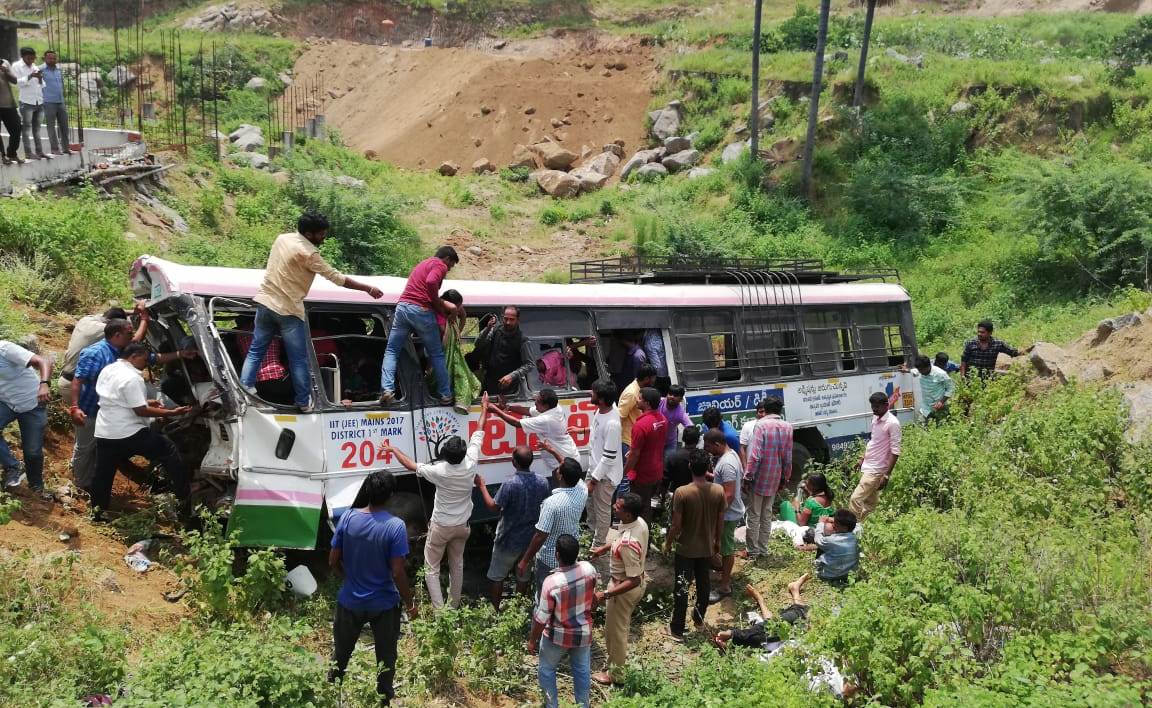
40 killed as bus falls into gorge in Telangana

September 11, 2018 by Nasheman


In a ghastly tragedy, 40 people were killed and more than 20 others injured when a state-owned bus fell into a gorge in Telangana’s Jagtial district on Tuesday, police said

The bus belonging to the Telangana State Road Transport Corp (TSRTC) fell off Kondagattu Ghat Road while returning from Anjaneya Swamy temple atop Kondagattu Hills, about 190 km from Hyderabad.

The bus, carrying more than 60 passengers, met with the accident when the driver reportedly lost control at a speed breaker.

The dead include 20 women and seven children. The toll could go up as the condition of some of the injured was stated to be critical.

Senior officials rushed to the scene and launched rescue and relief operations.

The injured were shifted to a government-run hospital in Jagtial. A few critically injured were shifted to hospitals in Karimnagar and Hyderabad.

Chief Minister K. Chandrashekhar Rao expressed shock over the accident. He announced Rs 5 lakh ex-gratia each for the families of the dead

(IANS)

Filed Under: News & Politics

Central government transfers 30 officers

September 11, 2018 by Nasheman


The Union government on Monday effected a major reshuffle in the mid-level bureaucracy transferring as many as 30 officers, most of them IAS, in various ministries and departments.

The government transferred the officers among the ministries and departments of home affairs, commerce, agriculture, coal, telecommunication, environment and forest, health, food, heavy industry, road transport, Niti Aayog and rural development besides the cabinet secretariat.

(IANS)

Filed Under: News & Politics

Labourers’ death: Delhi government orders compensation, probe

September 11, 2018 by Nasheman

The Delhi government on Monday announced Rs 10 lakh each for the five labourers who died following inhalation of toxic gas while cleaning a sewer tank in the national capital and has ordered a probe seeking a report in three days.

A statement from Delhi’s Labour Ministry said: “The Labour Minister wants a fact-finding inquiry conducted so as to decide the further course of action against the defaulting agencies/ firms.”

Labour Minister Gopal Rai in a tweet announced the compensation.

“The Arvind Kejriwal government will provide Rs 10 lakh each to the families of labourers who passed away in the incident,” Rai said.

Around 3 p.m on Sunday, the staff of DLF Green Apartments in west Delhi’s Moti Nagar informed the police that five labourers were trapped in a sewerage, Deputy Commissioner of Police Monika Bhardwaj said.

They were pulled out and taken to the hospital where Sarfaraz, Pankaj, Raja and Umesh were declared dead. Vishal, who was admitted to the RML Hospital in a critical condition, died during treatment, the officer said.

Union Minister and Lok Janshakti Party (LJP) leader Ram Vilas Paswan has called the incident “shameful and inhuman”.

“The LJP has been demanding for years an immediate ban on manual cleaning of sewer drains. For this, a law should be made immediately to provide for strict action and the guilty should be punished with imprisonment of at least 10 years,” he said in a statement.

(IANS)

Filed Under: News & Politics

Karnataka seeks Rs 2,000 cr, two central teams to assess damage

September 11, 2018 by Nasheman


Two central teams will visit Karnataka soon to assess the damage caused by rains and floods in seven of its districts in August, even as the state sought immediate release of Rs 2,000 crore for relief work.

“Prime Minister Narendra Modi on Monday assured a Karnataka delegation led by Chief Minister H.D. Kumaraswamy that the two teams of officers will visit Kodagu, Malnad and Dakshina Kannada districts to assess the damage,” a statement from the Chief Minister’s Office said in Bengaluru.

The assurance came after Kumaraswamy sought the immediate release of Rs 2,000 crore central package for rehabilitation of affected persons and rebuilding of infrastructure in the affected areas.

The Chief Minister had appraised Modi of the situation in the southwest districts due to floods as well as drought situation in the interior and northern districts of the state.

“The state has pegged the loss at Rs 3,706 crore, as the rainfall in August’s second week was the highest in the last 118 years, which caused floods and landslides and led to losses of agricultural and horticultural crops and plantation, as well as damage to houses and infrastructure in the affected districts,” the Chief Minister told Modi.

The Chief Minister told Modi that drought situation prevailed in 17 interior and northern districts due to deficit rains in the monsoon season.

“A Cabinet sub-committee is assessing the losses due to drought and a report will be sent to the central government for relief,” said the statement.

Former Prime Minister H.D. Deve Gowda, Deputy Chief Minister G. Parameshwara, Revenue Minister R.V. Deshpande, PWD Minister H.D. Revanna, Water Resources Minister D.K. Shivakumar and Parliamentary Affairs Minister Byre Gowda were part of the delegation.

“The state has been facing drought conditions in the last 13 years. As per preliminary estimates, agricultural and horticultural crops over 15 lakh hectares have been affected, with an estimated loss of Rs 8,000 crore,” Kumaraswamy told reporters after the meeting in New Delhi.

Deshpande said crops on 23,123 hectares was affected due to floods, resulting in Rs 1,242-crore losses to farmers.

“There has been a dry spell till date and if it continues, about 50 per cent crop will be lost,” Deshpande said, adding that Modi had promised immediate financial assistance.

According to the state government’s assessment, the damage to infrastructure due to floods was about Rs 1,789 crore.

Last month, Kumaraswamy met Home Minister Rajnath Singh and sought special central package of Rs 2,000 crore.

(IANS)

Filed Under: News & Politics

US wants India-Pakistan talks in conducive atmosphere

September 11, 2018 by Nasheman


 The United States wants India and Pakistan to engage in dialogue but feels a conducive atmosphere needs to be created first, a senior State Department official said on Monday.

“We have frequent conversations with our Indian partners on (Pakistan) bringing down cross-border terrorism,” said Alice Wells, the US Principal Deputy Secretary of State for South and Central Asia Affairs, while briefing the Indian media over telephone from the US on the the first-ever India-US 2+2 Ministerial Dialogue held here on September 6.

Stating that Prime Minister Narendra Modi has already talked with his new Pakistani counterpart Imran Khan, Wells said: “We need conditions to be created for a constructive dialogue.”

The US statement reflects New Delhi’s position that talks and terror cannot go together.

Wells said that the US would like to work with Pakistan to establish stability and political settlement in Afghanistan.

US Secretary of State Mike Pompeo had also expressed similar view when he stopped over in Islamabad on September 5, ahead of the first-ever India-US 2+2 Ministerial Dialogue held in New Delhi the next day.

“Secretary Pompeo’s trip to Pakistan was another opportunity for the Secretary to meet the new civilian leadership there and describe the aspirations we have for the (US-Pakistan) bilateral relationship,” Wells said.

“We would like to be able to work with Pakistan to establish stability and a political settlement in Afghanistan.”

Wells said the US-Pakistan relationship will be about whether Washington can stop Islamabad from supporting terrorists using its soil.

“There has been a very consistent message during Secretary Pompeo’s visit about our desire to work with Pakistan productively, constructively and the kind of concerns we have,” she said.

She also referred to US President Donald Trump’s new South Asia Strategy, describing it as a decisive step that states what the US believes needs to be done to bring stability in the region.

(IANS)

Filed Under: World

Can the trapped Paris Climate Agreement be rescued? By Rajendra Shende

September 11, 2018 by Nasheman

Two months ago, all 12 boys and the coach of a Thai football team were rescued after being trapped in a cave in northern Thailand for 18 days. Many termed their rescue against heavy odds a miracle.

Sadly, the six-day United Nations Special Climate Conference that concluded on September 9 was not able to rescue the trapped Paris Climate Agreement in the well-lit conference centre in southern Thailand. Many of the delegates wondered if it was about pronouncing the promises only to dodge them.

The Paris Climate Agreement has been hanging from a cliff right from the day US President Donald Trump, a year back, announced his official plan to withdraw from it. Though hundreds of American mayors and thousands of businesses — and even its allies like France — have been seeking to defy the consequences of Trump’s withdrawal, the agreement is getting dangerously close to its fatal consequence.

The good news is that the Paris Agreement has entered into force on November 4, 2016, in less than a year from its consensus adoption on December 12, 2015, in Paris. However, it is yet to be operationalised because its modalities, procedures and guidelines are yet to be agreed upon by its 180 Parties (countries that ratified the Paris Agreement). Indeed, the Paris Agreement in its present form is just an agreement of intent.

These “rules”, as per the time-table agreed in Paris, have to be ready no later than 2018. The Bangkok Climate Conference was a late addition to the schedule after dismal progress was made at the annual meeting of the subsidiary bodies of the United Nations Framework Convention on Climate Change ( UNFCCC) in Bonn in May 2018. The Bangkok Climate Conference was the last major negotiating meeting before the 24th Conference of the Parties (COP-24) in Poland in December, when finally the Paris Agreement will be in mission mode.

The exercise in Bangkok turned out to be progress in planning but a stalemate in its objective of operationalising. The Paris Agreement remains trapped in a complex maze of the caves of finance for mitigation and adaptation for the developing countries, deployment of market mechanisms, periodicity of stocktaking and transparency, flexibility for developing countries in reporting.

Formulating the rules on the cyclic and iterative nature by enhancing the nationally determined contributions (NDCs), earlier considered an innovation in international agreements, is now proving to be formidable.

It all boils down to the fact that world is now setting the new norms of not keeping the promises made on global cooperation. Not walking the talk and smartly gyrating the agreed goals is now the global attire of the diplomacy. And each of these new patterns are being justified, sometimes diplomatically and, many times with international arrogance.

Take, for example, financing for mitigation and adaptation for the developing countries. The “polluter to pay” norm has been the anchor in the multilateral environment agreements right from the 1992 Rio Agreement, but is now being openly flouted. The promise of providing “additional” finance through the Green Climate Fund (GCF), which was first proposed by then Secretary of State Hillary Clinton and then President Barack Obama in Copenhagen in 2009, is supposed to become fully operational in 2020, i.e. developed countries would provide — starting with $10 billion per year in 2012 to reach $100 billion per year from 2020 onwards — to help developing countries pay for climate adaptation and mitigation.

What has happened to that promise? As of today, GCF has pledges of $10.4 billion whereas the actually committed is only $3.5 billion. The GCF as institution itself is in chaotic state. The GCF head, an Australian, abruptly resigned in July 2018 after just two years in the job because of “personal reasons”. The deputy head from Nicaragua did not even attend the July meeting of GCF, where no projects were approved. “GCF is melting down faster than Antarctica,” one of the delegates in Bangkok said.

In Bangkok, the developed countries smartly proposed to count all the finances provided by the private sector, philanthropy, FDI and regular international development aid of 0.7 per cent of the GDP as part of the promised $100 billion. They also proposed dilution of the financial reporting rules, thereby flouting the agreement on “additional climate financing”.

Not walking the full talk by the star performers on climate change has also resulted in the angry reaction from civil society, and supported by countries, on such climate-hypocrisy.

An example is the Global Climate Action Summit convened from September 12 to 14, 2018, in San Francisco, under the leadership of California Governor Jerry Brown. The summit’s theme is “Take Ambition to the Next Level”. It will be a star-studded international event to showcase climate action at all levels and to inspire enhanced commitments and god-speed action from countries to realise the goals of the Paris Agreement. Indeed, California, the richest US state, has done more in policy setting and its implementation in the field of renewable energy and energy efficiency than any other country in the world. Its firebrand governor can be termed as climate’s game-changer.

In Bangkok, Brown was booed by civil society representatives for his soft approach towards oil producers in California by allowing them to drill for oil. “How can we expect a leader to take climate ambitions to the next level when he himself, from the back-door, takes it to a lower level,” queried one demonstrator in Bangkok.

When state leaders arrive in Poland in December, they would have to muddle through the mess of the draft “rule book” mired in diminishing trust. By that time, the GHGs concentration, already higher by 42 percent as compared to 1992 levels, would have risen to the “next level”.

A rescue operation for the trapped Paris Agreement would be near impossible.

[IANS]

Filed Under: World

A riveting tale of an extraordinary Indian By M.R. Narayan Swamy

September 11, 2018 by Nasheman

It will be an understatement to say this is a gripping book, sympathetic yet critical. With his passion for meticulous research, Philip Goldberg has authored what is undoubtedly one of the most stirring and brilliant accounts of a spiritual master, Paramhansa Yogananda, delving in particular into his life in the US that have largely remained shrouded in mystery. The result is this profound biography.

Goldberg makes it clear that he is not a disciple of Yogananda, which makes the book all the more enriching. Yogananda (born Mukund Lal Ghosh in Gorakhpur) achieved global fame with his 1946 masterpiece “Autobiography of a Yogi”. That seminal book is the reason why he still casts a spell, although he passed away decades ago. A professional writer for more than 40 years, Goldberg decided to essay Yogananda’s life because although the yoga guru spent almost all his adult years in America, less than 10 per cent of the “Autobiography…” is about that immensely productive and historically significant period.

Goldberg’s wide-ranging research led him to conclude that Yogananda, his quirks and idiosyncrasies notwithstanding, was an extraordinary human being, a spiritual prodigy, psychically gifted with exceptional inner powers and without doubt a self-realised yogic master. From a young age, he stalked God the way “Sherlock Holmes stalked criminals”.

But for one who moved to the US in 1920 unsure of his English, life wasn’t easy.

With his ochre robes and long hair, his mere appearance could invite ridicule, torment and even abuse. He endured sneers, glares, name-calling and even stone-throwing, but maintained his dignity. Worse, there were times when Yogananda and his close group didn’t have enough to buy food, so they would simply fast for a few days, says Goldberg, uncovering details never known before. Building the network he eventually did in the US was no joke because it was a time of coin-operated phone booths, long-distance operators, telegrams and letter writing. But Yogananda did it.

Only a handful of people came to his earlier “satsangs”. The numbers grew slowly, through word of mouth, as Yogananda began wandering across the length and breadth of America — much like Adi Shankara did in India centuries earlier. He went everywhere he could: Miami, Seattle, Oregon, Los Angeles, New York, Cleveland, Colorado, Boston, Utah.

Yogananda’s very name played a role in popularising yoga, then an unknown subject in the West. As he toured America, every time his name was mentioned or appeared in print, “yoga” became further legitimised in public mind. For someone who was reticent about public speaking at first, he became quite a performer. No wonder, his gatherings — where he spoke about God, yoga, meditation, the oneness of humankind — began to attract as many as 5,000 to 6,000 people. There were occasions when visitors had to be turned away because the venues were overflowing. A time came when The Los Angeles Times would call him “the 20th century’s first superstar guru”.

How did Yogananda succeed? Although his ingredients always contained elements from Hinduism, including karma, dharma, reincarnation, mantras, chakras and core principles of Vedanta, the combination of scientific rationality and respect for the Judeo-Christian tradition would become hallmarks of Yogananda’s teaching. Yogananda, says Goldberg, took the veneration of Christ a step further, producing a massive volume of written and spoken commentary on Jesus and his teachings. This triggered problems too. He was accused of selling out to attract Christian followers and also of “Chritistianising” Hinduism. His introduction of kirtan to America has been largely under-appreciated, the author says.

Once Yogananda attained VIP status, he was welcomed to the White House by President Calvin Coolidge (1923-29). Indeed, he had genuine love for America. He said the US was the most spiritual country, next only to his own India. He also met Mexican President Emilio Candido Portes Gil. What is noteworthy is that Yogananda makes no mention of these personal achievements in his “Autobiography…”, which is more about saints he met in his quest for God and less about himself.

But a time came when Yogananda had to face the worst of America: Media sensationalism, religious bigotry, ethnic stereotyping, sexual allegations and brazen racism. Life became difficult during the World War years as it affected revenue from class fees, books and magazine sales. Donations plunged. Worse, people he though were his soul mates suddenly ditched him and took him to court, causing him immense pain. On one occasion, he begged the Divine Mother: “Free me. Let me go back to India to serve you there.” It was not to happen.

Yogananda kept saying that he was using business in religion and not making a business of religion — as evidenced by the fact that no one was profiting financially from his work. When he returned to the US after a brief visit to India in the 1930s, he was detained for four days by US authorities for some obscure technical reason. But nothing derailed the “serious man with a serious and singular mission, a determined, disciplined, demanding dynamo who slept only three or four hours a night”. But Yogananda was fun-loving too. He loved popular comic strips like “Blondie” and “Bringing Up Father”. He loved to fly kites. And as a cook, he was a perfectionist.

Goldberg is clear that allegations of sexual derailment hurled at him have no basis. “Had I found verifiable evidence that Yogananda had sexual affairs or exploited female disciples, I would not have hesitated to report it. But I did not… My research did not uncover any credible evidence that Yogananda ever broke his vow of celibacy… No woman ever claimed to have had sexual relations with Yogananda — not even in posthumous letters, diaries or memoirs.”

In 1946, Yogananda took advantage of a change in immigration laws and applied for citizenship. His application was approved in 1949 and he became a naturalised US citizen. It was the year he took a train to San Francisco to meet Jawaharlal Nehru, India’s first Prime Minister. And when he died, Yogananda was speaking about India.

According to Goldberg, Yogananda’s crowning achievement, and the most enduring monument to his earthly expedition, was the “Autobiography of a Yogi”. It has sold millions of copies and continues to be a best-seller. But in 1946, publisher after publisher rejected it — until the Philosophical Library went for it. That book, along with Yogananda’s other writings, has had a religious and spiritual impact that “is unique and unassailable”. As Goldberg says, no single person contributed more to East-West current than Yoganand

[IANS]

Filed Under: India

WhatsApp now available on Reliance Jio Phone

September 11, 2018 by Nasheman

New Delhi Facebook-owned WhatsApp on Monday announced it is now available on Reliance JioPhones across India.

WhatsApp has built a new version of its private messaging app for JioPhone, running on KaiOS operating system.

“Millions of people across India can now use WhatsApp private messaging on the best-in-class JioPhone across India,” said Chris Daniels, Vice President, WhatsApp, in a statement.

The new app makes it easy to record and send voice messages with just couple of taps on the keypad.

To get started, JioPhone users only need to verify their phone number and then they can begin chatting with other WhatsApp users, one-on-one or in groups.

“We will be providing WhatsApp, the most used chat application in the world, on all JioPhones starting today (Monday). Jio wants to thank the Facebook and WhatsApp team for making this happen,” said Akash Ambani, Director, Reliance Jio Infocomm Ltd.

WhatsApp is available in the JioPhone AppStore starting September 10 and will be rolled out on all JioPhones by September 20, the company said.

People can download WhatsApp on both JioPhone and JioPhone 2 by visiting the AppStore.

(IANS)

Filed Under: India

  • « Previous Page
  • 1
  • …
  • 1280
  • 1281
  • 1282
  • 1283
  • 1284
  • …
  • 1904
  • Next Page »

Follow Us

  • Facebook
  • Twitter
  • YouTube

KNOW US

  • About Us
  • Corporate News
  • FAQs
  • NewsVoir
  • Newswire
  • Realtor arrested for NRI businessman’s murder in Andhra Pradesh

GET INVOLVED

  • Corporate News
  • Letters to Editor
  • NewsVoir
  • Newswire
  • Realtor arrested for NRI businessman’s murder in Andhra Pradesh
  • Submissions

PROMOTE

  • Advertise
  • Corporate News
  • Events
  • NewsVoir
  • Newswire
  • Realtor arrested for NRI businessman’s murder in Andhra Pradesh

Archives

  • February 2026 (6)
  • January 2026 (12)
  • December 2025 (6)
  • November 2025 (8)
  • October 2025 (12)
  • September 2025 (25)
  • August 2025 (46)
  • July 2025 (110)
  • June 2025 (28)
  • May 2025 (14)
  • April 2025 (50)
  • March 2025 (35)
  • February 2025 (34)
  • January 2025 (43)
  • December 2024 (83)
  • November 2024 (82)
  • October 2024 (156)
  • September 2024 (202)
  • August 2024 (165)
  • July 2024 (169)
  • June 2024 (161)
  • May 2024 (107)
  • April 2024 (104)
  • March 2024 (222)
  • February 2024 (229)
  • January 2024 (102)
  • December 2023 (142)
  • November 2023 (69)
  • October 2023 (74)
  • September 2023 (93)
  • August 2023 (118)
  • July 2023 (139)
  • June 2023 (52)
  • May 2023 (38)
  • April 2023 (48)
  • March 2023 (166)
  • February 2023 (207)
  • January 2023 (183)
  • December 2022 (165)
  • November 2022 (229)
  • October 2022 (224)
  • September 2022 (177)
  • August 2022 (155)
  • July 2022 (123)
  • June 2022 (190)
  • May 2022 (204)
  • April 2022 (310)
  • March 2022 (273)
  • February 2022 (311)
  • January 2022 (329)
  • December 2021 (296)
  • November 2021 (277)
  • October 2021 (237)
  • September 2021 (234)
  • August 2021 (221)
  • July 2021 (237)
  • June 2021 (364)
  • May 2021 (282)
  • April 2021 (278)
  • March 2021 (293)
  • February 2021 (192)
  • January 2021 (222)
  • December 2020 (170)
  • November 2020 (172)
  • October 2020 (187)
  • September 2020 (194)
  • August 2020 (61)
  • July 2020 (58)
  • June 2020 (56)
  • May 2020 (36)
  • March 2020 (48)
  • February 2020 (109)
  • January 2020 (162)
  • December 2019 (174)
  • November 2019 (120)
  • October 2019 (104)
  • September 2019 (88)
  • August 2019 (159)
  • July 2019 (122)
  • June 2019 (66)
  • May 2019 (276)
  • April 2019 (393)
  • March 2019 (477)
  • February 2019 (448)
  • January 2019 (693)
  • December 2018 (736)
  • November 2018 (570)
  • October 2018 (611)
  • September 2018 (692)
  • August 2018 (666)
  • July 2018 (468)
  • June 2018 (440)
  • May 2018 (616)
  • April 2018 (772)
  • March 2018 (338)
  • February 2018 (157)
  • January 2018 (188)
  • December 2017 (142)
  • November 2017 (122)
  • October 2017 (146)
  • September 2017 (176)
  • August 2017 (201)
  • July 2017 (222)
  • June 2017 (155)
  • May 2017 (205)
  • April 2017 (156)
  • March 2017 (178)
  • February 2017 (195)
  • January 2017 (149)
  • December 2016 (143)
  • November 2016 (169)
  • October 2016 (165)
  • September 2016 (137)
  • August 2016 (115)
  • July 2016 (116)
  • June 2016 (124)
  • May 2016 (170)
  • April 2016 (150)
  • March 2016 (199)
  • February 2016 (201)
  • January 2016 (216)
  • December 2015 (210)
  • November 2015 (174)
  • October 2015 (281)
  • September 2015 (241)
  • August 2015 (250)
  • July 2015 (188)
  • June 2015 (216)
  • May 2015 (281)
  • April 2015 (306)
  • March 2015 (296)
  • February 2015 (280)
  • January 2015 (245)
  • December 2014 (286)
  • November 2014 (254)
  • October 2014 (185)
  • September 2014 (98)
  • August 2014 (7)

Copyright © 2026 · News Pro Theme on Genesis Framework · WordPress · Log in