• Home
  • About Us
  • Events
  • Submissions
  • Advertise
  • Contact Us
  • NewsVoir
  • Newswire
  • Nasheman Urdu ePaper

Nasheman

India's largest selling Urdu weekly, now also in English

  • News & Politics
    • India
    • Indian Muslims
    • Muslim World
  • Culture & Society
  • Opinion
  • In Focus
  • Human Rights
  • Photo Essays
  • Multimedia
    • Infographics
    • Podcasts
You are here: Home / Archives for Business & Technology

50% ATMs in India may shut by March, digitization to be hit: CATMi

November 22, 2018 by Nasheman


 Nearly 50 percent of Automated Teller Machines (ATMs) may be shut down by March 2019 due to unviability of operations, hitting hard both urban and rural population, and dealing a blow to the digitization policy, the Confederation of ATM Industry (CATMi) warned on Wednesday.

Currently, India has approximately 238,000 ATMs installed, of which around 113,000 ATMs, including 100,000 off-site and more than 15,000 white label ATMs, are expected to down shutters, said CATMi Director V. Balasubramanian.

“This would severely impact millions of beneficiaries under the Pradhan Mantri Jan Dhan Yojana who withdraw subsidies in form of cash through ATMs, besides urban centres, resulting in snaky queues and chaos akin to post-demonetisation,” Balasubramanian told IANS.

He said the CATMi step is forced on account of recent regulatory guidelines for ATMs hardware and software upgrades, recent mandates on cash management standards and the Cassette Swap method of loading cash, entailing huge investments by the industry.

Balasubramanian said to implement the Cassette Swap alone would need an additional outlay of Rs 3,500 crore for CATMi.

In April this year, the Reserve Bank of India (RBI) imposed stringent guidelines for ATMs service providers or their contractors followed by the Union Ministry of Home Affairs issuing similar directives vide gazette notification to be implemented by February 9.

These include a minimum net worth requirement of Rs 100 crore, minimum fleet size of 300 fully-equipped cash vans, two custodians and two armed guards plus a driver, GPS-CCTV, and later in June came the diktat for upgradation of the software from WindowXP to Window10.

“To implement all these security, software-hardware directive would entail an additional cost of minimum Rs 150,000 per ATM per month. This works out to astronomical figures for all the 238,000 ATMs in the country,” Balasubramanian pointed out.

“However, the RBI-MHA directives are to be implemented by the banks which must bear the costs, but they are not willing to discuss the issue, leaving us to fend for ourselves. Accordingly, from January onwards, we shall progressively start shutting down the ATMs,” he said.

Of the approximately 238,000 ATMs in the country, an average 10 percent are non-functional at any given point of time for various reasons.

However, to adequately cater to the entire country’s population, the need is almost three-four times more, or around a million ATMs, says CATMi.

Of these (238,000 ATMs), nearly 80 percent are located in urban or semi-urban areas and the rest in rural areas.

Major industry players say that barring the metros and urban centres, people in states like Uttar Pradesh, Maharashtra, Bihar, West Bengal, Madhya Pradesh and others have to travel 40 km or more to access an ATM.

“Moreover, as per official data, barely 30 per cent of bank account holders in the country regularly use their ATM cards… the others prefer cash transactions. There are problems of infrastructure and connectivity which hamper growth of ATMs network,” Balasubramanian said.

India has among the lowest ATM penetration globally, averaging 8.9 ATMs per 100,000 population, compared to Brazil’s 119.6, Thailand’s 78, South Africa’s 60 and Malaysia’s 56.4.

China has a staggering one million ATMs, which will touch 1.5 million by 2020.


IANS

Filed Under: Business & Technology

Sensex, Nifty at day’s low; cede initial gains

November 22, 2018 by Nasheman

  The key equity indices traded at their respective day’s low during the afternoon session of trade on Thursday after ceding initial gains owing to profit booking. S&P BSE Sensex lost over 550 points in the last two days.

Although the indices traded in the red, the overall market breadth was positive with 1,245 advances and 1,159 declines.

Also, a decline in crude oil prices and a strengthening rupee capped further losses. The domestic currency rose to Rs 71.13 from its previous close of 71.45 while the benchmark Brent Crude traded $63.37 a barrel.

Heavy selling pressure was witnessed in the metal and power stocks which fell over 1 per cent whereas the index pivotals — finance and banking — were 0.27 per cent and 0.66 per cent lower from its previous close.

At 1.21 p.m., the S&P BSE Sensex traded 48.58 points lower at 35,251.03 from its previous close of 35,199.80.

The benchmark index touched a high of 35,364.50 and a low of 35,162.23 while NSE’s Nifty was trading 0.25 points lower at 10,573.85.

IANS

Filed Under: Business & Technology

J&K Governor feels democracy is outdated: Chidambaram

November 22, 2018 by Nasheman


Taking umbrage to the sudden dissolution of the Jammu and Kashmir Assembly, former Union Minister and Congress veteran P. Chidambaram on Thursday claimed that for BJP-appointed Governor Satya Pal Malik, parliamentary democracy was “outdated”.

A day after Malik’s dramatic move dissolving the House shortly after the Peoples Democratic Party (PDP), National Conference and the Congress came together to stake claim to form a government, Chidambaram took to Twitter to express his outrage.

“As long as no one staked a claim to form government, Jammu and Kashmir Governor was happy to keep Assembly under suspension. The moment someone staked a claim, he dissolved the Assembly.

“Parliamentary democracy standing on its head,” said the former Union Finance Minister.

“The Westminster model of democracy is outdated. Like in all other matters, it is the Gujarat model that has appealed to the J&K Governor,” said Chidambaram.

Besides, both National Conference’ Omar Abdullah and PDP chief Mehbooba Mufti, have also questioned the decision.

IANS

Filed Under: Business & Technology

Infosys, Skoda among 1,775 entities served notice for failure to file returns

November 20, 2018 by Nasheman

 Infosys Foundation, Skoda Auto India, University of Rajasthan and Madras Christian College are among 1,775 entities issued show-cause notice under the Foreign Contribution (Regulation) Act for their failure to submit annual income and expenditure statements on foreign fundings, officials said on Tuesday.

The Union Home Ministry issued the notice on November 16 after these entities failed to file returns for up to six consecutive financial years from 2011-12 to 2016-17 despite reminders.

In its notice, the Ministry said these entities or associations have not submitted online their income and expenditure statements, receipts, payment account details and balance sheets.

The Ministry warned that if they fail to submit the returns for the said period by December 1, 2018, “appropriate action” will be taken under the FCRA.

Apart from Infosys, Skoda Auto India, University of Rajasthan, Madras Christian College, the entities and associations served the notice include the Shree Siddhivinayak Ganapati Temple Trust, Mumbai; Loyola College Society, Vijayawada; Guru Harkrishan Education Society, Chandigarh; and Allahabad Agricultural Institute.

The National Association for the Blind, Gujarat; Vivekananda Seva Sadan, West Bengal; Bombay Memons’ Education Society; Rajiv Gandhi Social Service Centre, Madurai; Jawahar Sarvodya Vikas Samiti, Nalanda, Bihar; Indira Mahila Bikash Samiti, Odisha; Nehru Yuva Sankalp Sansthan, Rajasthan; and Jain Vishva Bharati Institute, a deemed university located at Nagaur in Rajasthan are among those served the notice.

Young Men’s Christian Association, Kutch, Gujarat; Midas Trust, Mumbai; Mewat Educational and Development Society, Haryana; North East Institute of Fashion Technology, Guwahati; and Jamia Islamia Ashraf Ul Ullom Arabic Education Public Charitable Trust, Visakhapatnam were also served the shjow-cause notice.

The FCRA provides that associations registered under the Act shall submit electronically online annual report with scanned copies of income and expenditure statements, receipts and payment accounts, balance sheets etc., for every financial year within nine months of the closure of the financial year.

The associations which do not receive foreign contribution during a particular year are also required to furnish a NIL return for that financial year within the aforesaid period.

Earlier, a similar notice was served on April 24, 2018 to these associations advising them to submit annual report or accounts of the missing years electronically online immediately.

“…the said associations are hereby directed to explain within a period of 15 days from the date of issue of this show-cause notice as to why appropriate action under the FCRA may not be initiated against them,” the notice read.

IANS

Filed Under: Business & Technology

Sensex jumps amid bets of RBI-government truce

November 19, 2018 by Nasheman

 Key equity indices jumped amid bets the government and the Reserve Bank of India will bury their differences at a crucial central bank board meeting on Monday.

Subdued global oil prices, and foreign fund inflows amid a stable domestic currency also burnished the appeal of stocks.

The government has been demanding that the RBI make liquidity available, especially to the shadow banks after a series of defaults by the Infrastructure Leasing & Financial Services (IL&FS) triggered a scare and precipitated a credit crunch.

The Centre has also reportedly demanded that the RBI hand over a significant chunk of its reserves, which was subsequently denied by the Union Finance Ministry as “misinformed speculation”.

RBI Deputy Governor Viral Acharya had warned of economic consequences if the central bank’s autonomy was encroached upon.

Interest-rate sensitive stocks like banking, automobile and capital goods rose, while the oil and gas sector came under pressure.

The S&P BSE Sensex settled up 317.72 points or 0.90 per cent at 35,774.88, from its previous close of 35,457.16 points.

NSE’s Nifty50 gained 81.20 points or 0.76 per cent to finish at 10,763.40.

IANS

Filed Under: Business & Technology

RBI Governor resignation would be send bad signal to global markets

November 19, 2018 by Nasheman

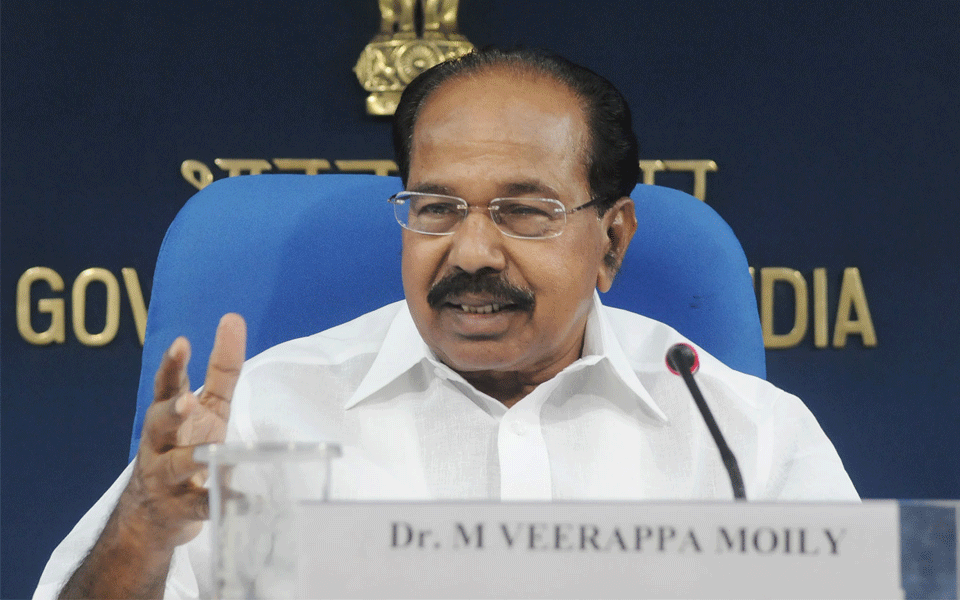
Amid demands from some quarters for RBI governor Urjit Patel’s resignation, Chairman of the Parliamentary Standing Committee on Finance Veerappa Moily Sunday said if he quits over the stand-off between the top bank and the Centre, it will send a bad signal to global markets.

“If Patel decides to resign over its (RBI) differences with the central government, it will be a very sad and bad for the Indian economy.

It will also send a bad signal to global markets just as Raghuram Rajan’s exit did,” the former Union Minister told PTI here.

He said responding to a query on reports that there were demands from some quarters for Patel to step down as RBI governor in view of the stand-off.

Noting that RBI’s credibility would be shaken if Patel resigns, Moily said the entire world economy looks up to any central bank of any country and the markets would also be affected.

His remarks come ahead of RBI’s crucial board meeting Monday with Finance Ministry nominees and some independent directors expected to take on Patel and his team over several issues, though both sides are in favour of reaching a common ground.

Moily claimed that the nation used to be very proud of India’s growing economy because its fundamentals were strong during the 10-year UPA rule unlike in the four-and-a-half years of NDA rule.

“When Arun Jaitley presented the first budget of the NDA, the economic survey report said the fundamentals of the economy were strong, that means it is a compliment to the Congress regime.

If the economic survey is presented today can they (NDA) say with confidence that the fundamentals of the economy are strong? The answer is no,” he contended.

“This only implies that the four-and-a-half years of NDA rule has destroyed and eroded the fundamentals of the country’s economy. That is the big tragedy of the present government at the centre,” he added.

To another query on reports that the government was planning to constitute panels to monitor functions of RBI, Moily said it would be a “very bad” idea.

“Having a managing committee over the regulator is a very bad idea and is unknown in world economy.. No country practises it.

RBI cannot be managed as a government department. It is an independent autonomous organisation which has been created by an act of Parliament,” he said.

“Patel is willing to have discussions with the government. Even the previous RBI governor Raghuram Rajan was keen on it.

The finance ministry can call a meeting every month to discuss with RBI to sort out misunderstandings if any. They cannot be solved by orders and interferences,” Moily suggested.

PTI

Filed Under: Business & Technology

India-Singapore Hackathon boost to technology, youth power: Modi

November 15, 2018 by Nasheman

Presenting awards to six winners of the first-ever India-Singapore Hackathon here on Thursday, Prime Minister Narendra Modi said the platform would boost technology, innovation and youth power.

The top six teams — three each from India and Singapore — were chosen after a final pitching session.

The winning teams from India were from Indian Institute of Technology Kharagpur (IIT Kharagpur), National Institute of Technology, Tiruchirappalli (NIT Trichy) and MIT College of Engineering, Pune.

Among the winning teams from Singapore were Nanyang Technological University (NTU) and the Singapore University of Technology and Design (SUTD).

“Platforms like the Singapore-India Hackathon serve as excellent opportunities for our youngsters to showcase their work. They also serve as forums to learn about pioneering innovations by youngsters from other nations and institutes. A win-win for our students!,” Modi said.

A first prize of SGD 10,000, a second prize of SGD 6,000 and a third prize of SGD 4,000 was announced for each of the three winners from India and Singapore.

After meeting the winners of the hackathon, Modi said he was “impressed by their passion and commitment towards solving problems our world faces”.

The Prime Minister arrived in Singapore on Wednesday on a two-day visit to attend the East Asia Summit, Asean-India informal meet and the Regional Comprehensive Economic Partnership (RCEP) Summit.

He also delivered the keynote address at the Singapore Fintech Festival (SFF) on Wednesday.

Twenty teams each from both countries comprising university and college students were selected for the Hackathon. Each team had three students and one dedicated mentor.

They participated in the 36-hour long hackathon working on 20 problem statements. The hackathon ended with the “Grande Finale” on Wednesday.

The problem statements for the hackathon were in the areas of mapping, synchronised output of diverse social media, shared digital identity verification, effective number estimate, space management and allotment, effective learning, and personal security.

Filed Under: Business & Technology

India’s heaviest rocket lifts off with communication satellite GSAT-29

November 14, 2018 by Nasheman

 India’s heaviest rocket – Geosynchronous Satellite Launch Vehicle-Mark III (GSLV-Mk III)– carrying 3,423 kg communication satellite GSAT-29 blasted off from the Sriharikota spaceport on Wednesday evening.

Precisely at 5.08 p.m. the GSLV-Mk III rocket on its second developmental flight began its ascent with a strong deep growl that reverberated like a thunder roll breaking free from the second launch pad here at the Satish Dhawan Space Centre (SDSC).

The 43.4-metre rocket weighing about 640 tonne rushed to the blue skies with thick orange flame at its rear.

The GSLV-Mk III with a capacity to carry four-tonne satellite, is a three-stage/engine rocket with two strap-on motors powered by solid fuel. The second stage is a core liquid fuel booster and the third is the cryogenic engine.

The Indian space agency had flown a similar rocket on June 5, 2017, with GSAT-19 satellite. Prior to that ISRO had flown another rocket with 3.7-tonne dummy payload in 2014 to test its in-flight structural stability and aerodynamics.

On Wednesday, just over 16 minutes into its flight the rocket will sling the GSAT-29 at its intended orbit at an altitude of around 207 km.

According to Indian Space Research Organisation (ISRO), GSAT-29 with a life span of 10 years is a multi-beam satellite that carries Ka/Ku-band high throughput communication transponders intended to meet the communication requirements of users including those in remote areas.

In addition, several new technologies such as Q/V-band payload, data transmission through optical communication link will be demonstrated. This will help in realising future advanced satellites, ISRO said.

The satellite also carries a geo-high resolution camera.

India currently has two fully operational rockets — the Polar Satellite Launch Vehicle and GSLV-Mk II — with a lift-off mass of 415 tonnes and a carrying capacity of 2.5 tonnes.

Filed Under: Business & Technology

India’s October wholesale inflation rises to 5.28%

November 14, 2018 by Nasheman

 India’s annual rate of inflation based on wholesale prices rose to 5.28 per cent in October from 5.13 per cent in September, official data showed here on Wednesday.

Even, on a year-on-year (YoY) basis, the Wholesale Price Index (WPI) data furnished by the Ministry of Commerce and Industry was higher than 3.68 per cent reported for the corresponding period of 2017.

“The annual rate of inflation, based on monthly WPI, stood at 5.28 per cent (provisional) for the month of October (over October, 2017) as compared to 5.13 per cent (provisional) for the previous month and 3.68 per cent during the corresponding month of the previous year,” the data showed.

“Build up inflation rate in the financial year so far was 4.64 per cent compared to a build up rate of 2.12 per cent in the corresponding period of the previous year,” the Commerce Ministry official statement said.

On a sequential basis, the expenses on primary articles, which constitute 22.62 per cent of the WPI’s total weightage eased to 1.79 per cent, from a rise of 2.97 per cent in September.

Similarly, the prices of food articles declined. The category has a weightage of 15.26 per cent in the WPI index.

However, the cost of fuel and power segment, which commands a 13.15 per cent weightage, edged higher by 18.44 per cent from a growth of 16.65 per cent.

The expenses on manufactured products registered a rise of 4.49 per cent from 4.22 per cent.

On a YoY basis, onion prices declined by 31.69 per cent, whereas potatoes became dearer by 93.65 per cent.

In contrast, the overall vegetable prices in the month under review declined by 18.65 per cent, against a rise of 36.67 per cent in the same month a year ago.

Among the non-food items, the price of high-speed diesel rose by 19.85 per cent on a YoY basis, petrol by 31.39 per cent and LPG by 18.44 per cent.

Filed Under: Business & Technology

WhatsApp selects 20 teams to curb fake news globally, including India

November 13, 2018 by Nasheman

Facebook-owned WhatsApp on Tuesday announced that it has selected 20 research teams worldwide – including experts from India and those of Indian origin — who will work towards how misinformation spreads and what additional steps the mobile messaging platform could take to curb fake news.

Shakuntala Banaji from London School of Economics and Political Science (LSE), Anushi Agrawal and Nihal Passanha from Bengaluru-based media and arts collective “Maraa” and Ramnath Bhat from LSE have been selected for the paper titled “WhatsApp Vigilantes? WhatsApp messages and mob violence in India”.

The research examines the ways in which WhatsApp users understand and find solutions to the spate of “WhatsApp lynchings” that has killed over 30 people so far.

The Indian government has also directed WhatsApp to take necessary remedial measures to prevent proliferation of fake and, at times, motivated/sensational messages on its platform.

Among others selected were Vineet Kumar from Ranchi-headquartered Cyber Peace Foundation (principal investigator), Amrita Choudhary, President of the Delhi-based non-profit Cyber Café Association of India (CCAOI) and Anand Raje from Cyber Peace Foundation.

They will work as a team on the paper titled “Digital literacy and impact of misinformation on emerging digital societies”.

P.N. Vasanti from Centre for Media Studies in New Delhi woll work withS. Shyam Sundar, The Pennsylvania State University (Principal Investigator) to examine the role of content modality in vulnerability to misinformation, under the topic titled “Seeing is Believing: Is Video Modality More Powerful in Spreading Fake News?”

WhatsApp had issued a call for papers in July this year and received proposals from over 600 research teams around the world.

“Each of the 20 research teams will receive up to $50,000 for their project (for a total of $1 million),” WhatsApp said in a statement.

Lipika Kamra from O.P. Jindal Global University and Philippa Williams from the Queen Mary University of London (Principal Investigator) will examine the role of WhatsApp in everyday political conversations in India, in the context of India’s social media ecosystem.

According to Mrinalini Rao, lead researcher at WhatsApp, the platform cares deeply about the safety of its over 1.5 billion monthly active users globally and over 200 million users in India.

“We appreciate the opportunity to learn from these international experts about how we can continue to help address the impact of misinformation,” Rao said.

“These studies will help us build upon recent changes we have made within WhatsApp and support broad education campaigns to help keep people safe,” she added.

The recipients are from countries including Brazil, India, Indonesia, Israel, Mexico, Netherlands, Nigeria, Singapore, Spain, the UK and US.

WhatsApp said it is hosting them in California this week so they can hear from product leaders about how it builds its product.

“Given the nature of private messaging – where 90 per cent of the messages sent are between two people and group sizes are strictly limited – our focus remains on educating and empowering users and proactively tackling abuse,” said the company.

WhatsApp recently implemented a “forward label” to inform users when they received a message that was not originally written by their friend or loved one. To tackle abuse, WhatApp has also set a limit on how many forwards can be sent.

In India, WhatsApp has partnered with the Digital Empowerment Foundation to train community leaders in several states on how to address misinformation.

“We are also running ads in several languages — in print, online, and on over 100 radio stations — amounting to the largest public education campaign on misinformation anywhere in the world,” the company noted.

Sayan Banerjee from University of Essex, Srinjoy Bose from University of New South Wales and Robert A. Johns from University of Essex will study “Misinformation in Diverse Societies, Political Behaviour & Good Governance”.

Santosh Vijaykumar from Northumbria University, Arun Nair from Health Systems Research India Initiative and Venkat Chilukuri, Srishti Institute of Art, Design and Technology are part of the team that will study “Misinformation Vulnerabilities among Elderly during Disease Outbreaks”.


IANS

Filed Under: Business & Technology

  • « Previous Page
  • 1
  • …
  • 35
  • 36
  • 37
  • 38
  • 39
  • …
  • 87
  • Next Page »

Follow Us

  • Facebook
  • Twitter
  • YouTube

KNOW US

  • About Us
  • Corporate News
  • FAQs
  • NewsVoir
  • Newswire
  • Realtor arrested for NRI businessman’s murder in Andhra Pradesh

GET INVOLVED

  • Corporate News
  • Letters to Editor
  • NewsVoir
  • Newswire
  • Realtor arrested for NRI businessman’s murder in Andhra Pradesh
  • Submissions

PROMOTE

  • Advertise
  • Corporate News
  • Events
  • NewsVoir
  • Newswire
  • Realtor arrested for NRI businessman’s murder in Andhra Pradesh

Archives

  • February 2026 (6)
  • January 2026 (12)
  • December 2025 (6)
  • November 2025 (8)
  • October 2025 (12)
  • September 2025 (25)
  • August 2025 (46)
  • July 2025 (110)
  • June 2025 (28)
  • May 2025 (14)
  • April 2025 (50)
  • March 2025 (35)
  • February 2025 (34)
  • January 2025 (43)
  • December 2024 (83)
  • November 2024 (82)
  • October 2024 (156)
  • September 2024 (202)
  • August 2024 (165)
  • July 2024 (169)
  • June 2024 (161)
  • May 2024 (107)
  • April 2024 (104)
  • March 2024 (222)
  • February 2024 (229)
  • January 2024 (102)
  • December 2023 (142)
  • November 2023 (69)
  • October 2023 (74)
  • September 2023 (93)
  • August 2023 (118)
  • July 2023 (139)
  • June 2023 (52)
  • May 2023 (38)
  • April 2023 (48)
  • March 2023 (166)
  • February 2023 (207)
  • January 2023 (183)
  • December 2022 (165)
  • November 2022 (229)
  • October 2022 (224)
  • September 2022 (177)
  • August 2022 (155)
  • July 2022 (123)
  • June 2022 (190)
  • May 2022 (204)
  • April 2022 (310)
  • March 2022 (273)
  • February 2022 (311)
  • January 2022 (329)
  • December 2021 (296)
  • November 2021 (277)
  • October 2021 (237)
  • September 2021 (234)
  • August 2021 (221)
  • July 2021 (237)
  • June 2021 (364)
  • May 2021 (282)
  • April 2021 (278)
  • March 2021 (293)
  • February 2021 (192)
  • January 2021 (222)
  • December 2020 (170)
  • November 2020 (172)
  • October 2020 (187)
  • September 2020 (194)
  • August 2020 (61)
  • July 2020 (58)
  • June 2020 (56)
  • May 2020 (36)
  • March 2020 (48)
  • February 2020 (109)
  • January 2020 (162)
  • December 2019 (174)
  • November 2019 (120)
  • October 2019 (104)
  • September 2019 (88)
  • August 2019 (159)
  • July 2019 (122)
  • June 2019 (66)
  • May 2019 (276)
  • April 2019 (393)
  • March 2019 (477)
  • February 2019 (448)
  • January 2019 (693)
  • December 2018 (736)
  • November 2018 (570)
  • October 2018 (611)
  • September 2018 (692)
  • August 2018 (666)
  • July 2018 (468)
  • June 2018 (440)
  • May 2018 (616)
  • April 2018 (772)
  • March 2018 (338)
  • February 2018 (157)
  • January 2018 (188)
  • December 2017 (142)
  • November 2017 (122)
  • October 2017 (146)
  • September 2017 (176)
  • August 2017 (201)
  • July 2017 (222)
  • June 2017 (155)
  • May 2017 (205)
  • April 2017 (156)
  • March 2017 (178)
  • February 2017 (195)
  • January 2017 (149)
  • December 2016 (143)
  • November 2016 (169)
  • October 2016 (165)
  • September 2016 (137)
  • August 2016 (115)
  • July 2016 (116)
  • June 2016 (124)
  • May 2016 (170)
  • April 2016 (150)
  • March 2016 (199)
  • February 2016 (201)
  • January 2016 (216)
  • December 2015 (210)
  • November 2015 (174)
  • October 2015 (281)
  • September 2015 (241)
  • August 2015 (250)
  • July 2015 (188)
  • June 2015 (216)
  • May 2015 (281)
  • April 2015 (306)
  • March 2015 (296)
  • February 2015 (280)
  • January 2015 (245)
  • December 2014 (286)
  • November 2014 (254)
  • October 2014 (185)
  • September 2014 (98)
  • August 2014 (7)

Copyright © 2026 · News Pro Theme on Genesis Framework · WordPress · Log in