• Home
  • About Us
  • Events
  • Submissions
  • Advertise
  • Contact Us
  • NewsVoir
  • Newswire
  • Nasheman Urdu ePaper

Nasheman

India's largest selling Urdu weekly, now also in English

  • News & Politics
    • India
    • Indian Muslims
    • Muslim World
  • Culture & Society
  • Opinion
  • In Focus
  • Human Rights
  • Photo Essays
  • Multimedia
    • Infographics
    • Podcasts
You are here: Home / Archives for Business & Technology

Sensex reclaims 38,000 mark, Nifty up 120 points

September 14, 2018 by Nasheman


The benchmark S&P BSE Sensex reclaimed the 38,000 mark on Friday afternoon, supported by a recovery in the rupee and positive global markets.

The NSE Nifty50 also surged around 120 points during the afternoon session of trade. So far, sector-wise, consumer durables stocks led the increase in the market.

The Indian rupee on Friday recovered after the recent slump and around 1.10 p.m. the rupee traded around 71.60 per US dollar, against the previous close of 72.19 per dollar.

Globally equity markets traded higher after reports said that the US and China may hold fresh talks on trade tariffs issue.

Further, the Wholesale Price Index for August, released on Friday, eased to 4.53 per cent from 5.09 per cent in July, which firmed up the domestic investor sentiment.

Index-wise, the wider Nifty50 on the National Stock Exchange traded at 11,490.45 points (1.25 p.m.), higher by 120.55 points or 1.06 per cent from its previous close.

The S&P BSE Sensex, which had opened at 37,939.29 points, traded at 38,022.67 points, higher by 304.71 points or 0.81 per cent than the previous close of 37,717.96 points.

So far, it has touched an intra-day high of 38,058.92 points and a low of 37,859.52 points.

The markets remained closed on Thursday on the ocassion of Ganesh Chaturthi.

Filed Under: Business & Technology

India playing leading role in lowering global emissions: Anand Mahindra

September 14, 2018 by Nasheman


India is already playing a leading role in lowering global emissions. The country’s efforts in mainstreaming renewable energy and energy efficiency are remarkable. These, and its ambition in the electric mobility space, are admired across the globe, says Mahindra Group Executive Chairman Anand Mahindra.

For him, climate change needs to be addressed and he has called on businesses worldwide to commit to science-based targets (SBTs), which aimed to reduce emissions as underpinned by the historic 2015 Paris Climate Change Agreement, the first-ever legally binding treaty adopted by 197 countries that came in force on November 4, 2016.

“India’s social programmes like Ujala (bio-mass to LPG) and Swachh Bharat are very innovative and effective ways of addressing the issues of both planet and people on a large scale where they can actually create a positive impact,” Mahindra told IANS in an interview here.

He’s hereto co-chair the Global Climate Action Summit (GCAS) that aims to encourage all stakeholders to raise their ambition with many new possibilities emerging out of the discussions.

A firm believer that climate change needs to be addressed, he was categorically clear in saying that no nation can afford to ignore this.

“But as I said earlier, everyone needs to do more. There is a lot that developed countries are doing and we look forward to the steps they take as these actions help the global effort, due to advances in technology that others can learn from and emulate.”

On the status on the adoption of science-based climate targets, Mahindra said nearly three years on from Paris, the race is on to meet the target of holding global temperature rise to under two degrees Celsius, helping avoid the worst effects of climate change by achieving peak greenhouse gas emissions by 2020.

“At this summit, new evidence will be presented to demonstrate that companies around the world, and in some of the highest-emitting industries, are taking action to make the transition to the low-carbon business models of the future.”

Currently, 20 Mahindra Group companies have signed up for the science-based climate targets, with Mahindra Sanyo Special Steels being the first steel company in the world to get its targets approved.

This covers more than 90 per cent of the Group’s emissions and other Group companies are in the process of signing up for these targets, he said.

Mahindra sees business value in adopting these targets that he announced to commit at the World Economic Forum in January this year.

“We have already seen remarkable value in reducing emissions through the EP100 programme which aims to double energy productivity in our main businesses — auto, farm equipment and holiday resorts. Science-based targets are a way of ensuring that ambition is stepped up and action is aligned to the target set by the Paris Agreement.”

“The need for sustainability in business is creating a tectonic shift of mindset, as dramatic as moving from smoke signals to Skype. The scale involved in moving from combustion engines to electric, from conventional to alternative energy, opens up a new world of business possibilities.”

He said the creation of new technologies and leveraging them to create new businesses is a huge opportunity for the future.

This includes retro-fitting homes, buildings, and factories, to make them more energy efficient; and manufacturing literally billions of energy efficient appliances for lighting, heating, cooking, cooling, and washing for every home.

“We are talking about massive scale once consumers change their lifestyle. The potential investment in wind and solar energy alone, over the next two decades, is six trillion dollars.

“Beside the business case for sustainability, we as a company have discovered that everything we have done to reduce greenhouse gas emissions has given us a financial return.”

An optimistic Mahindra said the GCAS would encourage all stakeholders to raise their ambition with many new possibilities emerging out of the discussions.

The commitments made in the lead-up to GCAS have already created momentum and GCAS will help carry this through.

As a platform to address the challenge of climate change, the GCAS to my mind is already a success.

“For me, the work toward GCAS began at Davos when we issued the SBT (science-based targets) challenge to other global corporations. The challenge has gained huge momentum and more than 470 companies have already signed up for these SBTs.

“I am sure that the conversations at GCAS will sustain and even increase the momentum that has been created. We have Indian steel and cement companies that have come forward to sign onto these SBTs. These sectors are known to be hard-to-abate, yet Indian companies have shown vision and ambition in taking this action. These point toward strong signs of success for GCAS already,” he said.

The three-day climate action summit, an initiative by California Governor Jerry Brown, began here on Wednesday amidst the presence of 4,000-plus business leaders, investors, citizens and government representatives from all over the world, coming together with the united resolve to “take ambition to the next level”.

(IANS)

Filed Under: Business & Technology

Floods to have long-term negative impact on Kerala, Karnataka coffee growers

September 14, 2018 by Nasheman


The devastating floods in Kerala and Karnataka will not just cause one-fifth of the coffee production to be wiped out this year but its aftershocks are expected to have a long-term negative impact on farmers.

Ruined plantations would take several years to return to life and a part of those that survived might die due to the rotting of their roots. One estimate places the losses in three districts of Karnataka alone at Rs 700 crore.

There will also be a huge financial bearing on the beleaguered farmers to arrange resources for recovery of the damaged trees and re-establish the dead coffee gardens, Ramesh Rajah, President of the Coffee Exporters Association of India, said.

“According to the Coffee Board, about 1,000 hectares of coffee garden area have been flattened due to the landslides triggered by the heavy rains. Every big tree in (shed-grown) plantations that has fallen has damaged at least 10-20 coffee trees,” Rajah told IANS.

Before the monsoon, the total coffee output for this year was pegged at over 3.5 lakh tonnes. However, the estimates have been brought down to 2.8-3 lakh tonnes post the flash-floods-led disaster in both southern states.

According to the Coffee Board of India, the total production of coffee in 2015-16 was 3.48 lakh tonnes while it was estimated to be 3.12 lakh tonnes in 2016-17.

Rajah said there were fears that some of the coffee trees that survived the floods might “die slowly” due to the root-rotting as they were submerged for a long time.

Karnataka Revenue Minister R.V. Deshpande said the coffee plantations on 2.26 lakh hectares of land were affected, leading to huge losses to the farmers.

“Coffee plantations in Kodagu, Hassan and Chikmagalur have been badly damaged. The Coffee Board is assessing the magnitude of the damage. But the tentative figures show the losses are around Rs 700 crore,” Deshpande told IANS.

According to sources, the central government is working on a special package for the cultivators based on the recommendations of the Commerce Ministry even as the Coffee Board is assessing the overall damage caused.

Karnataka accounts for 70-80 per cent of the country’s total coffee production while Kerala produces over 10 per cent and Tamil Nadu about 5 per cent. Andhra Pradesh, Odisha and the northeastern region, which come under the non-traditional coffee producing areas, account for the rest.

Arabica and Robusta are the two types of coffee grown in India.

B.M. Raju, who grows coffee beans on 60-acres of land in Karnataka’s Kodagu, said the damage in his district ranged from 20 to 80 per cent and farmers would have no option but to reinvest heavily to rejuvenate their gardens.

“The input cost is already high. Labour cost has increased in last few years. But after these floods, coffee cultivators are totally broken. We will have to raise a huge sum for replantation,” said Raju, who is a member of the Coffee Board.

The input cost includes expenses on seedlings, labour, irrigation, fertilisers, pesticides and chemicals.

Rajah said farmers had the “financial inability” to raise funds as they were already in distress.

Even if the cultivators manage to gather resources and carry out replantation, they will have to wait for at least five years for the returns when trees start bearing fruit.

Earlier, farmers would get 75-85 bags (each of 60 kg) of coffee beans per hectare. However, this time it would be just 12-25 bags in Kodagu, Raju said.

According to the Coffee Board, the overall farm productivity was 761 kg per hectare in 2016-17.

Rajah said the quality of coffee beans would not be good this year as their shape may not be round and the texture may be rough.

But K. Basavaraj, who heads the Coffee Board’s Quality Division, maintained that the quality would not be affected as the fruit development would happen after the rains.

“There would not be any impact on the bean quality in general. We have 3-4 months for recovery of plants and development of beans. Quality could be slightly below the normal in certain pockets where serious damage has been reported,” Basavaraj said.

He said plants in the minimal damage areas would recover by the next year but some pockets, especially in Kodagu where entire coffee estates have vanished, would take years to rebuild.

(IANS)

Filed Under: Business & Technology

Lower food prices ease India’s WPI to 4.53% in August

September 14, 2018 by Nasheman


A massive fall in food prices and cost of primary articles eased India’s annual inflation rate based on wholesale prices to 4.53 per cent in August from a 5.09 per cent rise in July.

However, on a year-on-year (YoY) basis, the Wholesale Price Index (WPI) furnished by the Ministry of Commerce and Industry on Friday was still higher than 3.24 per cent reported for the corresponding period of 2017.

“Build up inflation rate in the financial year so far was 3.18 per cent compared to a build up rate of 1.41 per cent in the corresponding period of the previous year,” the Ministry statement said here.

On a sequential basis, the expenses on primary articles, which constitute 22.62 per cent of the WPI’s total weightage, slipped by (-) 0.15 per cent, from an increase of 1.73 per cent in July.

Similarly, the prices of food articles dipped. The category has a weightage of 15.26 per cent in the WPI index. It deflated by (-) 4.04 per cent from a rise of (-) 2.16 per cent.

Interestingly, the cost of fuel and power category, which commands a 13.15 per cent weightage, increased at a slower pace of 17.73 per cent from a growth of 18.10 per cent.

However, expenses on manufactured products registered a rise of 4.43 per cent from 4.26 per cent.

Filed Under: Business & Technology

Equity indices open in green on firm Asian cues

September 14, 2018 by Nasheman


The key Indian equity indices opened in green on Friday tracking similar cues from the Asian markets.

Healthy buying was witnessed in banking, oil and gas and metal counters.

The 51-scrip Nifty50 at the National Stock Exchange (NSE) opened at 11,443.50 points, against its previous close of 11,369.90 points.

At 9.42 a.m., the Nifty50 traded at 11,431.60 points, higher by 61.70 points or 0.54 per cent from its previous close.

The S&P BSE Sensex which had opened at 37,939.29 points, traded at 37,899.46 points, higher by 181.50 points or 0.48 per cent from its previous close of 37,717.96 points.

So far, it has touched an intra-day high of 38,058.92 points and low of 37,874.33 points.

Stock exchanges were closed on Thursday on account of Ganesh Chaturthi.

(IANS)

Filed Under: Business & Technology

After single-day halt, fuel prices continue to rise

September 14, 2018 by Nasheman


Fuel prices in the country resumed their upward movement on Thursday with prices hitting fresh highs in three of the four metro cities.

In the national capital, petrol price touched Rs 81 per litre, up from Rs 80.87 on Wednesday, according to data from the Indian Oil Corp website.

On Wednesday, prices were unchanged in three cities, except Kolkata, where fuel prices fell by a rupee after the West Bengal government cut excise duty by Re 1 per litre.

Transport fuel prices have been on a rise for around a month now, owing to higher crude oil prices coupled with a depreciating rupee. Any fall in the Indian rupee against the US dollar makes the import of crude oil expensive as the transaction is done in dollars.

Brent crude oil is currently priced over $79 per barrel. The rupee, on the other hand, slumped to a record low of 72.91 per dollar on Wednesday, before settling at 72.19 per greenback.

In Mumbai and Chennai, petrol was sold at an all-time high of Rs 88.39 and Rs 84.19 per litre respectively, both record levels, up from the previous Rs 88.26 and Rs 84.19 per litre.

In Kolkata too, the fuel price rose but did not surpass the all time high of Rs 83.75 on Tuesday. On Thursday, it was sold at Rs 82.87 in the West Bengal capital, up from the previous 82.74 per litre.

In tandem with the rise in petrol prices, diesel prices also climbed to fresh highs.

In Delhi, Mumbai and Chennai, diesel prices were at record levels of Rs 73.08, Rs 77.58 and Rs 77.25 respectively, up from the previous levels of Rs 72.98, Rs 77.47 and Rs 77.13 per litre.

Diesel price in Kolkata rose to Rs 74.93, against Wednesday’s 74.82 per litre. The all-time high in the city for diesel price is Rs 75.82, recorded on Tuesday.

(IANS)

Filed Under: Business & Technology

Digital commerce market to reach Rs 2.37 lakh cr: Report

September 14, 2018 by Nasheman


Digital commerce in India will reach Rs 2.37 lakh crore by December 2018, a report by the Internet and Mobile Association of India (IAMAI) said here on Thursday.

By the end of 2017, the market stood at Rs 2.04 lakh crore, the report said, adding that online travel industry covered 54 per cent of the total market value last year.

“Online travel industry continues to grow strongly with 54 per cent share while the share of online non-travel has improved over the previous year to reach 46 per cent,” the report added.

In December 2017, the share of e-tail was around 36 per cent of the total digital commerce spends, it said. The e-tail sector grew 23 per cent on a year-on-year basis.

According to the report, online utility payments market registered close to 63 per cent growth between 2016 and 2017.

Further, other online services market that includes online bookings for entertainment, online grocery, and online food delivery, was close to Rs 6,060 crore in December 2017.

(IANS)

Filed Under: Business & Technology

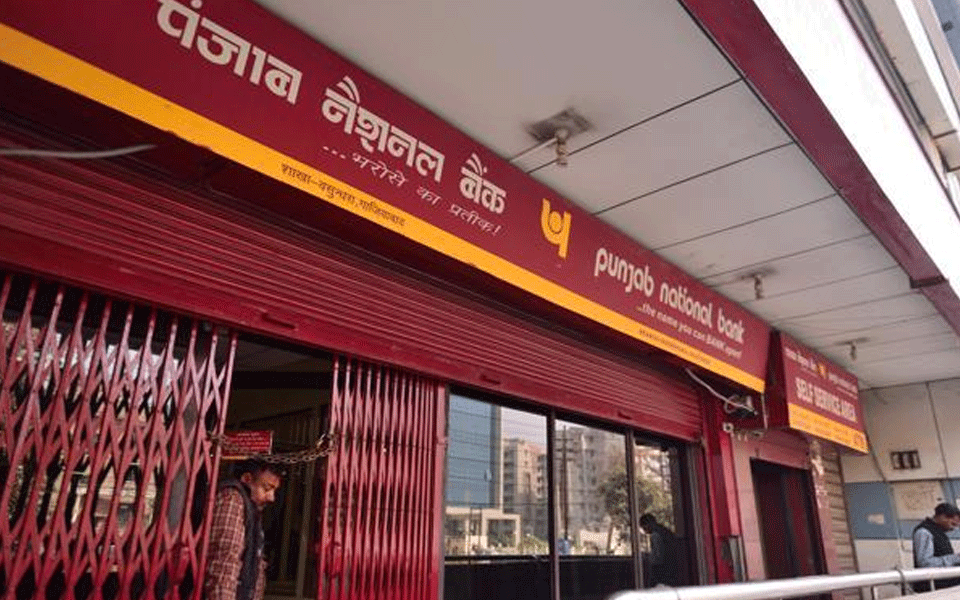
PNB to auction 21 bad loan accounts to recover Rs 1,320 cr

September 14, 2018 by Nasheman

State-run Punjab National Bank (PNB) has put 21 non-performing assets (NPAs), or bad loan accounts, on sale to recover over Rs 1,320 crore with the e-bidding auction process slated later this month.

PNB said in a notification earlier this week that its Stressed Assets Targeted Resolution Action (SASTRA) Division has put on sale these 21 accounts which cumulatively owe the bank Rs 1,320.19 crore.

“We intend to place these accounts for sale to ARCs (asset reconstruction companies) /NBFCs (non-banking finance companies)/other banks/FIs (financial institutions) etc, on terms and conditions stipulated in the bank’s policy, in line with the regulatory guidelines,” PNB said.

A PNB spokesperson said on Thursday that “the submission of financial bids will be only through e-auction which will take place on the bank’s portal on September 20.”

The bank’s NPA accounts up for sale include Moser Baer Solar with outstanding of Rs 233.06 crore, Divine Alloys & Power Co (Rs 200.87 crore), Divine Vidyut (Rs 132.66 crore), Chincholi Sugar & Bio Industries (Rs 114.42 crore), Arshiya Northern FTWZ Ltd Rs (96.70 crore), Birla Surya (Rs 73.58 crore) Shri Saikrupa Sugar & Allied Industries (Rs 63.35 crore) and Raja Forgings & Gears Ltd (Rs 59.73 crore).

Among the other major defaulters listed are Templeton Foods (Rs 53.17 crore), Rathi Ispat (Rs 45.48 crore) and Jain Overseas (Rs 33.41 crore).

(IANS)

Filed Under: Business & Technology

IAF chief backs Rafale deal

September 12, 2018 by Nasheman

Amid the rising clamour on the Rafale deal, the Indian Air Force Chief, Air Chief Marshal B.S. Dhanoa, on Wednesday said by acquiring the French fighters the IAF was strengthening its depleting fleet.

“By providing the Rafale and the S-400 (anti-missile system), the government is strengthening the Indian Air Force to counter the shortfall of our depleting numbers of aircraft,” he said at an event here.

Pointing to IAF’s strength coming down to 31 squadrons from the sanctioned strength of 42, Dhanoa said India faced a shortage of fighter aircraft despite the threat of a two-front war with Pakistan and China.

“Very few countries are facing challenges like us. We have two nuclear-armed neighbours.We have to match neighbours Pakistan and China to tackle a two-front war,” he said.

The IAF chief’s comments come a day after former Bharatiya Janata Party ministers Yashwant Sinha and Arun Shourie alleged Prime Minister Narendra Modi’s “personal culpability” in the Rafale deal which they dubbed as the country’s “biggest defence scam”.

Earlier this month, the IAF Vice Chief, Air Marshal S.B. Deo too, had endorsed the Rafale, deal saying the aircraft will give India “unprecedented combat capabilities”.

Besides BJP rebels Sinha and Shourie, the Congress led by its President Rahul Gandhi has been relentlessly attacking the Modi government over the jet deal that was announced by the Prime Minister in 2015.

(IANS)

Filed Under: Business & Technology

Markets open on high note on Wednesday

September 12, 2018 by Nasheman


The 30-scrip Sensitive Index (Sensex) on Wednesday opened on a positive note during the morning session of the trade.

The Sensex of the BSE after opening at 37,546.42 points touched a high of 37,638.16 points and a low of 37,432.66 points.

The Sensex is trading at 37,499.11 points up by 85.98 points or 0.23 per cent from its Tuesday’s close at 37,413.13 points.

On the other hand, the broader 51-scrip Nifty at National Stock Exchange (NSE) opened at 11,476.85 points after closing at 11,438.10 points on Tuesday.

The Nifty is trading at 11,287.50 points in the morning.

(IANS)

Filed Under: Business & Technology

  • « Previous Page
  • 1
  • …
  • 51
  • 52
  • 53
  • 54
  • 55
  • …
  • 87
  • Next Page »

Follow Us

  • Facebook
  • Twitter
  • YouTube

KNOW US

  • About Us
  • Corporate News
  • FAQs
  • NewsVoir
  • Newswire
  • Realtor arrested for NRI businessman’s murder in Andhra Pradesh

GET INVOLVED

  • Corporate News
  • Letters to Editor
  • NewsVoir
  • Newswire
  • Realtor arrested for NRI businessman’s murder in Andhra Pradesh
  • Submissions

PROMOTE

  • Advertise
  • Corporate News
  • Events
  • NewsVoir
  • Newswire
  • Realtor arrested for NRI businessman’s murder in Andhra Pradesh

Archives

  • February 2026 (6)
  • January 2026 (12)
  • December 2025 (6)
  • November 2025 (8)
  • October 2025 (12)
  • September 2025 (25)
  • August 2025 (46)
  • July 2025 (110)
  • June 2025 (28)
  • May 2025 (14)
  • April 2025 (50)
  • March 2025 (35)
  • February 2025 (34)
  • January 2025 (43)
  • December 2024 (83)
  • November 2024 (82)
  • October 2024 (156)
  • September 2024 (202)
  • August 2024 (165)
  • July 2024 (169)
  • June 2024 (161)
  • May 2024 (107)
  • April 2024 (104)
  • March 2024 (222)
  • February 2024 (229)
  • January 2024 (102)
  • December 2023 (142)
  • November 2023 (69)
  • October 2023 (74)
  • September 2023 (93)
  • August 2023 (118)
  • July 2023 (139)
  • June 2023 (52)
  • May 2023 (38)
  • April 2023 (48)
  • March 2023 (166)
  • February 2023 (207)
  • January 2023 (183)
  • December 2022 (165)
  • November 2022 (229)
  • October 2022 (224)
  • September 2022 (177)
  • August 2022 (155)
  • July 2022 (123)
  • June 2022 (190)
  • May 2022 (204)
  • April 2022 (310)
  • March 2022 (273)
  • February 2022 (311)
  • January 2022 (329)
  • December 2021 (296)
  • November 2021 (277)
  • October 2021 (237)
  • September 2021 (234)
  • August 2021 (221)
  • July 2021 (237)
  • June 2021 (364)
  • May 2021 (282)
  • April 2021 (278)
  • March 2021 (293)
  • February 2021 (192)
  • January 2021 (222)
  • December 2020 (170)
  • November 2020 (172)
  • October 2020 (187)
  • September 2020 (194)
  • August 2020 (61)
  • July 2020 (58)
  • June 2020 (56)
  • May 2020 (36)
  • March 2020 (48)
  • February 2020 (109)
  • January 2020 (162)
  • December 2019 (174)
  • November 2019 (120)
  • October 2019 (104)
  • September 2019 (88)
  • August 2019 (159)
  • July 2019 (122)
  • June 2019 (66)
  • May 2019 (276)
  • April 2019 (393)
  • March 2019 (477)
  • February 2019 (448)
  • January 2019 (693)
  • December 2018 (736)
  • November 2018 (570)
  • October 2018 (611)
  • September 2018 (692)
  • August 2018 (666)
  • July 2018 (468)
  • June 2018 (440)
  • May 2018 (616)
  • April 2018 (772)
  • March 2018 (338)
  • February 2018 (157)
  • January 2018 (188)
  • December 2017 (142)
  • November 2017 (122)
  • October 2017 (146)
  • September 2017 (176)
  • August 2017 (201)
  • July 2017 (222)
  • June 2017 (155)
  • May 2017 (205)
  • April 2017 (156)
  • March 2017 (178)
  • February 2017 (195)
  • January 2017 (149)
  • December 2016 (143)
  • November 2016 (169)
  • October 2016 (165)
  • September 2016 (137)
  • August 2016 (115)
  • July 2016 (116)
  • June 2016 (124)
  • May 2016 (170)
  • April 2016 (150)
  • March 2016 (199)
  • February 2016 (201)
  • January 2016 (216)
  • December 2015 (210)
  • November 2015 (174)
  • October 2015 (281)
  • September 2015 (241)
  • August 2015 (250)
  • July 2015 (188)
  • June 2015 (216)
  • May 2015 (281)
  • April 2015 (306)
  • March 2015 (296)
  • February 2015 (280)
  • January 2015 (245)
  • December 2014 (286)
  • November 2014 (254)
  • October 2014 (185)
  • September 2014 (98)
  • August 2014 (7)

Copyright © 2026 · News Pro Theme on Genesis Framework · WordPress · Log in