• Home
  • About Us
  • Events
  • Submissions
  • Advertise
  • Contact Us
  • NewsVoir
  • Newswire
  • Nasheman Urdu ePaper

Nasheman

India's largest selling Urdu weekly, now also in English

  • News & Politics
    • India
    • Indian Muslims
    • Muslim World
  • Culture & Society
  • Opinion
  • In Focus
  • Human Rights
  • Photo Essays
  • Multimedia
    • Infographics
    • Podcasts
You are here: Home / Archives for Business & Technology

Telangana keen to collaborate with UAE in blockchain

June 30, 2018 by Nasheman


Telangana is keen to collaborate with United Arab Emirates (UAE) in blockchain technologies, state IT Minister K. T. Rama Rao said on Friday.

He was talking to Minister of Foreign Affairs and International Cooperation Sheikh Abdullah Bin Zayed Al Nahyan who visited T-Hub, India’s largest startup incubator and appreciated the innovations being done here.

Rama Rao, who escorted the UAE delegation, said Telangana, like UAE, was focussed on blockchain and had a strong ambition to become the national leader in this domain.

Stressing that the state was keen to collaborate with UAE whose focus and priorities on blockchain were well recognized and respected, he said the state wanted to find best use cases to apply blockchain solutions in various domains of governance. He told the visiting delegation that the state will be hosting a major international blockchain Congress in Hyderabad in the first week of August.

Rao explained about opportunities of collaborating through the T-Hub with priority programmes of UAE and Telangana.

He proposed to create a market access program for UAE-based startups with a product or a solution relevant for the Indian market. He said Tech startups in the education space could be identified who can come up with innovative solutions for improving learning outcomes of the diverse range of students in UAE schools.

Rama Rao also offered to jointly explore opportunities for finding innovative solutions for common priorities in the areas of renewables, water, and other natural resources.

The UAE Minister extended an invitation to Rama Rao to visit and explore business opportunities in UAE to which the latter responded positively.

Rama Rao said that Telangana government continues to look for potential investments from UAE-based companies.

Outlining the Telangana government’s industrial policy, he said that Telangana has the most progressive industrial development and investment policy in the country, and currently rated number one in the ease of doing business.

“We have already received investment proposals from three leading UAE-based companies, and we are sure that we can become an ideal destination for any UAE investors who wish to set up their manufacturing units in India,” he added.

Filed Under: Business & Technology

India will be centre of ISA’s ‘sunshine’ countries: Prabhu

June 30, 2018 by Nasheman


India will be at the centre of the “sunshine” countries of the International Solar Alliance (ISA) promoted jointly by it and France, Commerce Minister Suresh Prabhu said on Friday.

Addressing the Renewable Energy Dialogue here, he also said that India has set a target of achieving 40 per cent of total electricity generation from non-fossil fuel sources by 2030.

“India is running one of the largest and most ambitious renewable energy capacity expansion programmes in the world. When achieved, this will place India at the centre of ‘Sunshine Countries’,” he said.

The ISA is currently promoting the development of solar power in over 120 countries.

The Minister also said the government’s target of installing 20 gigawatt (GW) of solar power by 2022 was achieved four years of ahead of schedule in January through setting up solar parks.

“India has set a fresh target of achieving 100 gigawatt of solar power by 2022,” he added.

Filed Under: Business & Technology

Sushil Modi rules out bringing petrol, diesel under GST

June 29, 2018 by Nasheman


GST Council Member and Bihar Deputy Chief Minister Sushil Modi on Friday outright ruled out bringing petroleum products under the ambit of Goods and Services Tax (GST) in near future, citing loss of revenue both to central and state governments.

He added there was no consensus in the GST Council on the issue yet and if such a decision was effected in a hurry, both the Central and the state governments would incur huge revenue losses.

Modi, the Bihar Finance Minister, added that even if petroleum products are brought under GST, there is no guarantee that they would attract a tax rate within 28 per cent and states may levy additional taxes for want of more revenue.

His statement comes days after NITI Aayog Vice Chairman Rajiv Kumar told IANS in an interview that petrol and diesel can’t be brought under GST any time soon since the total state and Central taxes on petrol put together are around 90 per cent right now.

He had said that no state will be willing to take a cut so huge and opening a new slab under GST would be an enormous exercise.

However, Modi said the Council could positively consider bringing in natural gas and aviation turbine fuel within the purview of GST.

Addressing a National Conclave on “GST – Growing Stronger Together” here, he said the GST slab of 28 per cent for certain products could be brought down only once the revenues stabilize at about Rs one lakh crore per month, a statement said.

The average monthly collection under GST stood at Rs 89,885 crore during 2017-18.

“Similarly, a three slab GST could also be possible at any rate between 12 per cent and 18 per cent once the monthly revenue collections move towards stability which will take time,” he added.

Filed Under: Business & Technology

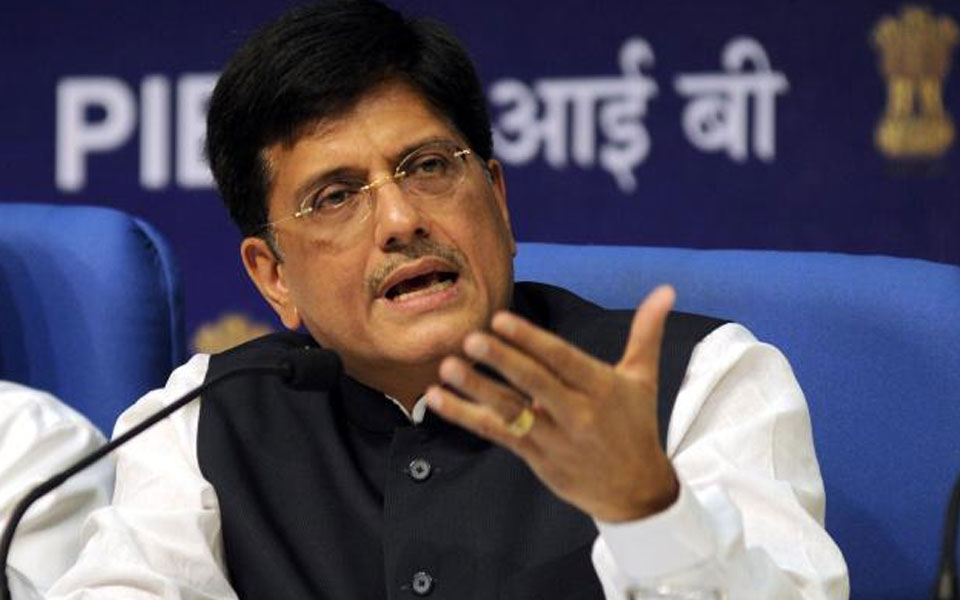
Swiss Bank deposits info will be available to the Govt as of 2018 says Piyush Goyal

June 29, 2018 by Nasheman


Data of money deposited by Indians in Swiss banks will be available to the government under an agreement signed with Switzerland for automatic exchange of information, Interim Finance Minister Piyush Goyal said on Friday.

The agreement for automatic exchange of information was signed between Switzerland and India last November under which both countries would start collecting data in accordance with the global standards in 2018 and exchange it from 2019, Goyal told reporters here on the sidelines of an Institute of Cost Accountants of India event.

He was responding to media questions on latest data released by the Swiss National Bank showing a rise in Indian deposits last year.

“Under an agreement signed by the Modi government with Switzerland, all this data from the period January 1, 2018, will be made available to us,” Goyal said.

“From what I understand (from media reports) 40 percent increase in foreign remittances are on account of the Reserve Bank’s Liberalised Remittance Scheme brought during the previous (UPA) government under which a resident Indian can remit $250,000 per year,” he said.

“Then there are also non-resident deposits in this. Rest assured, if there is any wrongdoing revealed, we will take action. With the various measures of this government against black money, Swiss bank deposits have been decreasing,” he added.

The data showed that after falling for three years in succession, money parked by Indians in Swiss banks rose 50 percent to Swiss Franc 1.02 billion in 2017 over the previous year.

Over the last three years among the measures taken by the Indian government to combat black money include the enactment of Black Money (Undisclosed Foreign Income and Assets) and Imposition of Tax Act, 2015, the Income Declaration Scheme in 2016 and the Pradhan Mantri Garib Kalyan Yojana last year.

Filed Under: Business & Technology

Some gain, some pain for realty under new taxation regime

June 29, 2018 by Nasheman


Amidst teething troubles and glitches in the implementation framework, the landmark reform of Goods & Services Tax (GST), ushering in a unified tax regime, has helped in speeding up real estate recovery and easing business transactions but has not lived up to its promise of providing significant price relief to consumers, even one year after its implementation.

Home buyers who had pinned high hopes on GST for reduction in property prices are disappointed as the overall cost of a property purchase has not come down — rather, in some cases, it has gone up.

The GST, which was introduced on July 1, 2017, has done away with multiple taxation of VAT, service tax, central excise duty, octroi, etc. In the pre-GST regime, the average tax burden on home buyers was about six per cent, though in some states, due to higher taxation, it was in double digits. However, in the GST regime, there is a single tax levy of 12 percent on the sale of under-construction residential property.

Though real estate developers are entitled to Input Tax Credit (ITC), against the purchase of construction material, yet its impact is said to be marginal in terms of tax relief.

Even in the affordable housing segment under the Pradhan Mantri Awas Yojana (PMAY), where the effective tax under GST works out to be eight per cent, after taking into account one-third abatement towards cost of land, there is no significant cost benefit.

For states where the net taxation in the pre-GST regime was on the higher side, there is no additional tax liability on home buyers, even if there is no cost benefit.

The real problem is that the benefit of ITC is not accruing to home buyers in terms of cost reduction as it is not effectively passed on to buyers due to its complex nature and lack of clarity.

There is still no clarity on abatement available for land cost for calculating service tax on under-construction projects, thereby having major implications on the final price.

According to Anuj Puri, Chairman, Anarock Property Consultants, the ITC confusion goes beyond percentage of rebate to mode and tranche of rebate due to the complexity of calculating it.

Ramesh Nair, CEO & Country Head, JLL India, further elaborates on the complexity of ITC: “There are different tax computation methods for different projects/phases of the same project. Further, there is ineligibility of refund to developers under the inverted duty structure, considering inputs are procured at a higher rate of tax whereas output is charged at a lower tax rate.”

Thus, builders are seeking to simplify the tedious process for filing returns and are asking for a more structured mechanism for legal protection against defaults.

Real estate developers engaged in affordable housing are also not too happy with the benefit of price reduction through GST. Affordable housing crusaders like Pradeep Aggarwal of Signature Global call for either abolishing or at least significantly reducing the tax rate to push affordable housing and realise the “Housing for All” mission.

Luxury housing developers also complain that as the land cost component is quite high in this segment, there is no significant corresponding benefit.

There is a case for subsuming stamp duty on property transactions in GST to make it much more effective in terms of price benefit. However, property buyers are reaping rich benefit of investing in ready residential properties as there is zero GST and no development risk.

There is yet another glaring aspect of GST: That it is restricted to under-construction residential projects and is not applicable to ready-to-move properties or to the secondary market. This, according to Honey Katyal, CEO, Investors Clinic (a leading real estate marketing company), may discourage buyers to book under-construction properties despite the fact that buying a ready property is always expensive and the relative impact of GST is almost nullified in that case.

Notwithstanding these teething problems, the positive impact of GST on the real estate sector as a whole cannot be overlooked. GST has made the realty sector more streamlined and transparent, with tax predictability, thereby boosting investors’ sentiments, leading to a spurt in foreign investments. And there is the emerging asset class within real estate – warehousing, which has got a major push with GST.

A recent World Wealth Report by Capgemini reveals that key reforms like GST and RERA have proved to be a major driver for reviving real estate. After a gap of about eight years, the equity capital market is witnessing a return of realty IPOs. And, as the government sets out to refine the architecture and compliance process of GST to make it more robust, a HSBC report says that, in the coming years, GST will lead to greater formalisation.

The government’s attempts to finetune GST, particularly its new proposal to reduce GST on construction material from 28 percent to 18 percent, will have a major positive impact on property costs, thereby realising the long-term goal of making housing affordable.

Filed Under: Business & Technology

One year of GST: Long way to go for a simple, uniform tax regime

June 28, 2018 by Nasheman


Touted as the biggest economic reform since Independence, the Goods and Services Tax (GST) was supposed to replace the complex indirect tax system prevalent in the country with a more simplified, uniform regime.

As its roll-out completes one year on June 30, it can be argued that while India has come a long way from a complicated taxation system, with over a dozen different taxes and many more cesses, GST is still far away from an ideal taxation regime.

Also, the one year journey of the GST has not been a smooth one either with glitches and teething problems experienced from day one. While many of those glitches were addressed by a proactive government, some still remain to be resolved including simplification of return filing and further rationalisation of tax rates.

According to NITI Aayog Vice Chairman Rajiv Kumar: “GST has put the economy on a completely different paradigm now because more and more pressure will be on people to register under GST and bring their economic activity into the formal sector.”

It is not enough only to analyse the one year journey, but it is important to understand the future roadmap.

While many economist would argue that an ideal GST structure should have a universal coverage and a single tax rate, most would also agree that it was not practical for a country like India with vast economic disparities. This is a stand the government has also maintained often giving the example that “a BMW car and a Hawai ‘chappal’ (flip-flops) can’t be taxed at the same rate”.

However, having six different rates — 5, 12, 18 and 28 per cent apart from some items being taxed at zero per cent and gold at 3 per cent — makes India’s GST one of the most complex in the world, something acknowledged by the World Bank in its biannual India Development Update report.

“To make things worse, petroleum products, power and real estate have been kept outside the GST ambit,” the report noted.

It added that not only India has one of the largest number of tax slabs, but at 28 per cent, it has the highest standard GST rate in Asia and the second highest in the world after Chile.

Soon after the new indirect tax system was rolled out, NITI Aayog Member Bibek Debroy — who is now also the chairman of the Prime Minister’s Economic Advisory Council — had told IANS that “India is a long way off from the ideal GST structure and it may not get there anytime in the near future”.

Favouring a maximum of three GST rates with all items covered, Debroy had said that starting with seven rates, “depending on how you count it”, has put India in a situation where it may not get to the ideal GST.

Fast forward to present. The economy is still grappling with the rather high multiplicity of tax rates while also debating bringing petroleum products, electricity and other items into the GST net with little clarity in the picture.

While there has been expression of intent by the government to merge some of the tax slabs, there has been little progress on that front so far.

Right from the first day of the roll-out on July 1 last year, there were technical glitches appearing on the GST Network portal causing a lot of hardship to taxpayers in registering on the network. There were often instances of the portal not being able to take the load of last-minute rush to file returns, forcing the government to postpone the filing deadlines several times.

The glitches also led to export refunds piling up, resulting in a grave situation of cash crunch for exporters, whose working capital was getting blocked.

However, to address this, the government initiated two special fortnight-long drives (extended by a few days later) to process pending refunds — one in March and another in June — clearing a major portion of the backlog while some still remains.

To address the GST network issues, the GST Council has set up a five-member ministerial panel headed by Bihar Deputy Chief Minister Sushil Modi to oversee its functioning and smoothen the process.

“GST is a very huge and complex exercise and one has to be honest that it could be implemented better and the details could have been (better) thought through,” the NITI Aayog’s Kumar told IANS.

While there was consensus that no reform could be undertaken without some glitches and teething problems, which could be addressed as we go along, one major concern was that GST might lead to some loss of revenue, especially for the states.

This fear almost came true when GST collections fell for two consecutive months from over Rs 92,000 crore (later revised to Rs 95,132 crore) in September to Rs 83,346 crore (later revised to Rs 85,931 crore) in October, and Rs 80,808 crore (later revised to Rs 83,716 crore) in November.

This prompted the GST Council in its December meeting to prematurely roll out the e-way bill mechanism for inter-state movement of goods from February 1 to plug gaps and check tax evasion.

The e-way bill portal crashed on Day One prompting the government to extend the trial period and eventually postponing the roll-out to April 1.

According to the NITI Aayog Vice Chairman, in a country like India, which is proud of its IT sector, there is hardly any excuse for the IT systems not to work.

However, when the system was rolled out the second time on April 1, the technical issues were sorted out and infrastructure boosted enough for a smooth implementation. The revenue collections also picked up subsequently crossing the Rs 1 lakh crore mark in March (collected in April) — which was, however, attributed to the financial year-end effect — and then again showing credible buoyancy in April when it crossed the Rs 94,000 crore.

Kumar said now that the GST has stabilised, it would give a massive fillip to economic activity.

Finance Secretary Hasmukh Adhia said earlier this week that GST had now entered a “smooth phase” with good tax compliance. He added the priority of the government would now be simplification of tax return forms.

Deloitte India Partner Prashant Deshpande said while GST has resolved the issues of multiple taxable events and double taxation, there are some concerns which still need to be addressed.

“On the legislation side, GST can be improved by extending it to petroleum products, electricity, land and building which are currently taxed under old laws… The number of tiers in tax rate structure are required to be reduced to resolve classification issues,” Deshpande told IANS.

On the execution side, he added, prime concern is the GST compliance infrastructure “which is complex and cumbersome” which needs to be replaced with “a simple and robust compliance system”.

It would a while before such a system comes into effect.

Filed Under: Business & Technology

‘Instagram Lite’ is quietly here to add another billion users

June 28, 2018 by Nasheman


In a bid to add another billion users from emerging markets including India, Facebook-owned Instagram has quietly released a lighter version of its app called “Instagram Lite” for Android on Google Play App Store.

Although there is no official statement yet from Facebook, the launch of ‘Instagram Lite’ app appears to a pilot run among a select countries to begin with.

There are millions of smartphone users in India who still have old variants with slow 2G Internet connectivity and “Instagram Lite” can help them get in touch with friends and family.

“The ‘Instagram Lite’ app is small, allowing you to save space on your phone and download it quickly,” read the app’s description on Play Store.

“At just 573 kilobytes, ‘Instagram Lite’ is 1/55th the size of Instagram’s 32MP main app. It lets you filter and post photos to the feed or Stories, watch Stories and browse the Explore page, but currently lacks the options to share videos or Direct message friends,” TechCrunch reported on Thursday.

With this new version of the photo messaging app, users using older phones with less storage space or slower internet connections, would have access to Instagram without having to delete photos, apps or wait longer and pay more to download it.

The app would run on Android versions 5.0 and up.

“We are testing a new version of Instagram for Android that takes up less space on your device, uses less data and starts faster,” an Instagram spokesperson told TechCrunch earlier.

With over a billion users, Instagram is a very popular app from the Facebook family.

Facebook launched “Facebook Lite” in 2015 which had 200 million users by the end of last year. Facebook “Messenger Lite” came in April this year.

Aiming to take on Google-owned YouTube, Instagram this month announced it would allow users to upload videos up to one hour in length, up from the previous one-minute limit.

“We launched IGTV (a button inside the Instagram home screen, as well as a standalone app) at an event featuring many of the Instagram creators who’ll make it great,” the company wrote in a blog post.

Not just celebrities, IGTV will let all users be a creator and let them upload vertical videos through Instagram’s app or the web.

Filed Under: Business & Technology

Cryptojacking surge a whopping 629% in Q1 2018: McAfee

June 28, 2018 by Nasheman


There were on average five new threat samples every second that resulted in a massive 629 percent growth in crypto jacking and other cryptocurrency mining malware in the first quarter of 2018, a new report said on Thursday.

The coin miner malware grew a stunning 629 percent to 2.9 million in the first quarter of 2018, from around 400,000 total known samples in Q4 2017, said the report from global cybersecurity firm McAfee.

Cybercriminals extended their operations in crypto jacking and other cryptocurrency mining schemes, where perpetrators hijack victims’ browsers or infect their systems to secretly use them to mine for legitimate cryptocurrencies such as Bitcoin.

“There were new revelations this quarter concerning complex nation-state cyber attack campaigns targeting users and enterprise systems worldwide,” said Raj Samani, Chief Scientist at McAfee.

“Bad actors demonstrated a remarkable level of technical agility and innovation in tools and tactics. Criminals continued to adopt cryptocurrency mining to easily monetize their criminal activity,” he added.

The Lazarus cybercrime group launched a highly sophisticated Bitcoin-stealing phishing campaign — HaoBao — which targeted global financial organizations and Bitcoin users.

When recipients open malicious email attachments, an implant would scan for Bitcoin activity and establishes an implant for persistent data gathering and crypto mining.

“In recent quarters, we have seen a shift to ransomware from data-theft, as ransomware is a more efficient crime. With the rise in the value of cryptocurrencies, the market forces are driving criminals to crypto-jacking and the theft of cryptocurrency,” said Steve Grobman, Chief Technology Officer at McAfee.

McAfee Labs counted 313 publicly disclosed security incidents in Q1 2018, a 41 percent increase over Q4.

“The incidents in healthcare sector rose 47 percent. Cybercriminals continued to target the sector with the ‘SAMSA’ ransomware, and there were numerous cases in which hospitals were compelled to pay the criminals,” the report revealed.

Incidents of attacks on the education sector rose 40 percent, with ransomware being a notable culprit in attacks on schools and related institutions.

Filed Under: Business & Technology

New Google Calandar features to improve your work schedule

June 28, 2018 by Nasheman


New features on Google Calendar like “out of office” and customizable “working hours” would let users indicate their work-time availability to others and improve digital presence, the company said on Thursday.

Google Calendar will now be able to automatically decline meetings that would occur during “out of office” period. Users will also have the choice to customize the “decline message.”

“When creating an event on the web, simply select the ‘out of office’ entry type. The ‘out of office’ object will have a different look on the Calendar grid, signaling to others that you’re unavailable,” the G suite team wrote in a blog post late on Wednesday.

Additionally, with “working hours”, users would be able to “protect their personal time from their work time”.

Users could set their working hours to one interval for all weekdays, or for each day, separately.

The new features will be available to users of all G suite editions within two weeks.

“Based on your timezone and past scheduling patterns, Google Calendar can now infer your working hours. You may see a prompt asking you to set them, and you can further customize them as needed,” the post added.

Filed Under: Business & Technology

US wants all countries,Including India to stop oil imports from Iran by November

June 27, 2018 by Nasheman


The US has asked all countries, including India, to stop all oil imports from Iran by November as it ruled out any exemption to India and Indian companies from its reimposed Iranian sanctions regime.

“On China and India, yes, certainly,” a state department official told reporters when asked if the US has told all countries, including India and China, to stop all their imports of Iranian oil by November 4.

He said Indian and Chinese companies would be subject to the same sanctions as those in other countries. Given the huge energy needs, India and China are major importers of Iranian oil.

“Their (India and China) companies will be subject to the same sanctions that everybody else’s are if they engage in those sectors of the economy that are sanctionable, where there were sanctions imposed prior to 2015. And yes, we will certainly be requesting that their oil imports go to zero. Without question,” the state department official said on condition of anonymity.

Responding to questions, the official said these countries should start reducing the import of oil from Iran now and bring it to zero by November 4. “Without question, they should be reduced. That’s what we’ve been telling them in our bilateral meetings. They should be preparing, now, to go to zero (by November 4),” the official
said.

The official said this is part of the Trump administration’s effort to isolate streams of Iranian funding and are looking to highlight the totality of Iran’s malign behaviour across the region.

“We remain engaged with the EU-3 throughout this process, and we are going to continue to branch out in new countries and reach new partners as the weeks go forward,” the official said.

As such, this could emerge as a major topic of discussion between India and the US during the first 2+2 dialogue next week. External Affairs Minister Sushma Swaraj and Defence Minister Nirmala Sitharaman would be in the US next week for talks with their American counterparts Secretary of State Mike Pompeo and Defence Secretary James Mattis.

The State Department asserted that there would be no waivers under the new sanctions regime. “I would be hesitant to say ‘zero waivers ever’. I think the predisposition would be, ‘No, we’re not granting waivers’,” the official said.

Noting that America’s allies are aware of its concern, the official claimed these countries want to work with the US. “I don’t want to get into the substance of each discussion I’ve had, but, for a vast majority of countries, they are willing to adhere and support our approach to this because they also view it as a threat. And it’s gotten worse since 2015, not better, on their regional activity side,” the official said.

In a recent report, the bipartisan Congressional Research Service (CRS) said as international sanctions on Iran increased in 2010-2013, India sought to preserve its longstanding ties with Iran while cooperating with the sanctions regime.

In 2010, the Reserve Bank of India ceased using a Tehran-based regional body, the Asian Clearing Union, to handle transactions with Iran. In January 2012, Iran agreed to accept India’s local currency, the rupee, to settle nearly half of its sales to India.

“During 2011-2015, India reduced its purchases of Iranian oil-at some cost to its own development-in order to receive from the US administration exemptions from sanctions. India has increased oil purchases from Iran to nearly pre-2012 levels after sanctions were lifted, and in May 2016 India agreed to transfer to Iran about USD 6.5 billion that it owed for Iranian oil shipments but which was held up for payment due to sanctions,” the report said.

“India’s position has generally been that it will only enforce sanctions authorised by UN Security Council resolutions, rendering it likely that India will resist US efforts to compel it to comply with reimposed US sanctions such as those that mandate cuts in oil purchases from Iran,” said the CRS report.

Filed Under: Business & Technology

  • « Previous Page
  • 1
  • …
  • 67
  • 68
  • 69
  • 70
  • 71
  • …
  • 87
  • Next Page »

Follow Us

  • Facebook
  • Twitter
  • YouTube

KNOW US

  • About Us
  • Corporate News
  • FAQs
  • NewsVoir
  • Newswire
  • Realtor arrested for NRI businessman’s murder in Andhra Pradesh

GET INVOLVED

  • Corporate News
  • Letters to Editor
  • NewsVoir
  • Newswire
  • Realtor arrested for NRI businessman’s murder in Andhra Pradesh
  • Submissions

PROMOTE

  • Advertise
  • Corporate News
  • Events
  • NewsVoir
  • Newswire
  • Realtor arrested for NRI businessman’s murder in Andhra Pradesh

Archives

  • February 2026 (6)
  • January 2026 (12)
  • December 2025 (6)
  • November 2025 (8)
  • October 2025 (12)
  • September 2025 (25)
  • August 2025 (46)
  • July 2025 (110)
  • June 2025 (28)
  • May 2025 (14)
  • April 2025 (50)
  • March 2025 (35)
  • February 2025 (34)
  • January 2025 (43)
  • December 2024 (83)
  • November 2024 (82)
  • October 2024 (156)
  • September 2024 (202)
  • August 2024 (165)
  • July 2024 (169)
  • June 2024 (161)
  • May 2024 (107)
  • April 2024 (104)
  • March 2024 (222)
  • February 2024 (229)
  • January 2024 (102)
  • December 2023 (142)
  • November 2023 (69)
  • October 2023 (74)
  • September 2023 (93)
  • August 2023 (118)
  • July 2023 (139)
  • June 2023 (52)
  • May 2023 (38)
  • April 2023 (48)
  • March 2023 (166)
  • February 2023 (207)
  • January 2023 (183)
  • December 2022 (165)
  • November 2022 (229)
  • October 2022 (224)
  • September 2022 (177)
  • August 2022 (155)
  • July 2022 (123)
  • June 2022 (190)
  • May 2022 (204)
  • April 2022 (310)
  • March 2022 (273)
  • February 2022 (311)
  • January 2022 (329)
  • December 2021 (296)
  • November 2021 (277)
  • October 2021 (237)
  • September 2021 (234)
  • August 2021 (221)
  • July 2021 (237)
  • June 2021 (364)
  • May 2021 (282)
  • April 2021 (278)
  • March 2021 (293)
  • February 2021 (192)
  • January 2021 (222)
  • December 2020 (170)
  • November 2020 (172)
  • October 2020 (187)
  • September 2020 (194)
  • August 2020 (61)
  • July 2020 (58)
  • June 2020 (56)
  • May 2020 (36)
  • March 2020 (48)
  • February 2020 (109)
  • January 2020 (162)
  • December 2019 (174)
  • November 2019 (120)
  • October 2019 (104)
  • September 2019 (88)
  • August 2019 (159)
  • July 2019 (122)
  • June 2019 (66)
  • May 2019 (276)
  • April 2019 (393)
  • March 2019 (477)
  • February 2019 (448)
  • January 2019 (693)
  • December 2018 (736)
  • November 2018 (570)
  • October 2018 (611)
  • September 2018 (692)
  • August 2018 (666)
  • July 2018 (468)
  • June 2018 (440)
  • May 2018 (616)
  • April 2018 (772)
  • March 2018 (338)
  • February 2018 (157)
  • January 2018 (188)
  • December 2017 (142)
  • November 2017 (122)
  • October 2017 (146)
  • September 2017 (176)
  • August 2017 (201)
  • July 2017 (222)
  • June 2017 (155)
  • May 2017 (205)
  • April 2017 (156)
  • March 2017 (178)
  • February 2017 (195)
  • January 2017 (149)
  • December 2016 (143)
  • November 2016 (169)
  • October 2016 (165)
  • September 2016 (137)
  • August 2016 (115)
  • July 2016 (116)
  • June 2016 (124)
  • May 2016 (170)
  • April 2016 (150)
  • March 2016 (199)
  • February 2016 (201)
  • January 2016 (216)
  • December 2015 (210)
  • November 2015 (174)
  • October 2015 (281)
  • September 2015 (241)
  • August 2015 (250)
  • July 2015 (188)
  • June 2015 (216)
  • May 2015 (281)
  • April 2015 (306)
  • March 2015 (296)
  • February 2015 (280)
  • January 2015 (245)
  • December 2014 (286)
  • November 2014 (254)
  • October 2014 (185)
  • September 2014 (98)
  • August 2014 (7)

Copyright © 2026 · News Pro Theme on Genesis Framework · WordPress · Log in