• Home
  • About Us
  • Events
  • Submissions
  • Advertise
  • Contact Us
  • NewsVoir
  • Newswire
  • Nasheman Urdu ePaper

Nasheman

India's largest selling Urdu weekly, now also in English

  • News & Politics
    • India
    • Indian Muslims
    • Muslim World
  • Culture & Society
  • Opinion
  • In Focus
  • Human Rights
  • Photo Essays
  • Multimedia
    • Infographics
    • Podcasts
You are here: Home / Archives for Environment

River linking could alter rainfall, hit monsoons, warns expert

December 6, 2014 by Nasheman

River linking

Kolkata: Criticising the interlinking of rivers (ILR) project of the Indian government, a leading geologist and environmental expert Friday warned the move could disrupt rainfall pattern which could be a significant issue in the wake of climate change.

“There is a major disruption of ecosystem. In view of climate change there is a possibility of change in pattern of rainfall,” V. Rajamani, an emeritus professor of the Jawaharlal Nehru University, New Delhi, told IANS here on the sidelines of a programme.

He was addressing students on climate change in India at a lecture organized by Indian National Science Academy (INSA) and West Bengal Academy of Science and Technology, at the Indian Institute of Chemical Biology here.

Rajamani, who has repeatedly expressed his reservations about the project, explained: “You may be damming a river, but the river might not have water if you don’t return the water to the sea.

“The marine water system will be disturbed and the physical process for the rainfall will be affected. You may not even get the monsoon.”

The ambitious ILR initiative which received a boost by the Narendra Modi-led government has 30 river-linking projects under its ambit and includes both peninsular and Himalayan rivers.

Union Water Resource, River Development and Ganga Rejuvenation Minister Uma Bharti has recently said ILR will raise irrigation capacity and will be taken up on mission mode.

However, Rajamani sounded a word of caution.

“Natural system works with natural laws’ give and take. How do you know it works? Americans are regretting they went for technology and now they are realising it is not working and now we are doing the same thing,” Rajamani said.

(IANS)

Filed Under: Environment, India Tagged With: Indian Rivers Inter-link, Rivers, V Rajamani, Water

Bhopal: A Metaphor

December 4, 2014 by Nasheman

'The 30th anniversary of Bhopal gas tragedy,' writes Shiva, 'should catalyse actions worldwide for justice for Bhopal and for all victims of an economy based on toxics.' (Photo: Bhopal Medical Appeal/flickr/cc)

‘The 30th anniversary of Bhopal gas tragedy,’ writes Shiva, ‘should catalyse actions worldwide for justice for Bhopal and for all victims of an economy based on toxics.’ (Photo: Bhopal Medical Appeal/flickr/cc)

by Vandana Shiva, The Asian Age

December 3, 2014, marks the 30th anniversary of the terrible Bhopal gas tragedy, which killed more than 3,000 people almost immediately, another 8,000 in the following days, and more than 20,000 in the last three decades.

Despite the tragedy of humongous proportions, the people of Bhopal are still fighting for justice despite the apathy they continue to face.

Bhopal was a watershed moment. The tragedy woke up the world to industrial, chemical violence. The chemicals being manufactured at the Bhopal plant had their roots in warfare.

Bhopal gas tragedy was a political, economic, legal watershed for India and the planet. It was a toxic tragedy at two levels the leakage of a toxic gas from a plant producing toxic pesticides, the continued presence of 350 metric tonnes of hazardous toxic waste from the now-defunct Union Carbide India Ltd’s plant in Bhopal, combined with a toxic influence of corporations on courts and successive governments. Legally, Union Carbide and the US courts escaped liability and responsibility for the damage, setting a precedent of governments shrugging their duty to protect their citizens, taking away citizens’ rights and sovereignty in order to make settlements with corporations, letting them off lightly.

The cases brought by the victims to US courts were dismissed on the grounds that the appropriate platform was the Indian legal system, though other cases involving US corporations and foreign victims were being heard in US courts. In 1999, when the victims again approached the US federal court seeking compensation for the 1984 incident as well as for the alleged ongoing environmental contamination at and around the Bhopal plant site, the case was dismissed again.

In 1989, the Indian Supreme Court approved a settlement of the civil claims against Union Carbide for $470 million. The state forcefully took over the representation of the victims on the principle of parens patriae (Latin for “parents of the nation”) — “a doctrine that grants the inherent power and authority of the state to protect persons who are legally unable to act on their own behalf”.

A criminal lawsuit against Union Carbide and Warren Anderson, its former CEO, continues since 1989. In June 2010, a court in India handed down a verdict in the case. It found Union Carbide India Ltd. and seven executives of the company guilty of criminal negligence (this came after the September 1996 order that had reduced their charges). The company was required to pay a fine of Rs 500,000 ($10,870) and the individuals were each sentenced to two years in prison and fined Rs 100,000. On August 2, 2010, the Central Bureau of Investigation filed a petition with the Supreme Court seeking to reinstate the charges of culpable homicide against the accused. In May 2011, the Supreme Court rejected this petition and declined to re-open the case to reinstate harsher charges. However, after the protests of the Bhopal survivors in November 2014, the government promised to strengthen the “curative petition” that Dow Chemical was already facing in the Supreme Court. The petition is designed to address inadequacies in the 1989 settlement on the basis that the correct figures for dead and injured were not used. The Indian government is seeking an additional amount of up to $1.24 billion, but Bhopal survivor groups, quoting the Government of India’s published figures (Indian Council of Medical Research, epidemiological report, 2004), say the required settlement amounts to $8.1 billion.

On February 6, 2001, Union Carbide Corporation became a wholly owned subsidiary of the Dow Chemical Company following an $11.6 billion transaction approved by the boards of directors of Union Carbide and the Dow Chemical Company. Owning means owning both, assets and liabilities. However, Dow would like to disown the Bhopal gas disaster. While Dow wants immunity from liability in the case of deaths and diseases caused by Union Carbide in Bhopal, it has accepted liability for harm caused to workers of Union Carbide in the US.

In January 2002, Dow settled a case brought against its subsidiary UCC by workers exposed to asbestos in the workplace and set aside $2.2 billion to address future liabilities.

The case was filed before the acquisition of Union Carbide by Dow. Dow refuses to address the death and damage caused by Union Carbide in India.

This pattern of double standards, of privatising profits and socialising disaster runs through the pattern of corporate rule being institutionalised since the Bhopal tragedy. Dow, along with Monsanto, is involved in pushing hazardous, untested GMOs on society, along with the same war-based chemicals such GMOs rely on.

On October 15, 2014, the Environmental Protection Agency, in spite of protests from citizens and scientists, gave final approval to Dow’s Enlist Duo genetically engineered corn and soya resistant to round-up and 2,4-D, or 2,4-Dichlorophenoxyacetic acid, which was one of the ingredients in Agent Orange, the Vietnam War defoliant that was blamed for numerous health problems suffered during and after the war.

As this chemical arms race unfolds, more and more communities and countries are making the democratic choice to become GMO free. In the mid-term elections of November 2014, Maui County of Hawaii voted to become GMO free. Dow and Monsanto immediately sued Maui to stop the law banning GMO cultivation.

The 30th anniversary of Bhopal gas tragedy should catalyse actions worldwide for justice for Bhopal and for all victims of an economy based on toxics. It should strengthen our resolve to create toxic-free food and agriculture systems, and to defend our freedom to be free of poisons.

Dr. Vandana Shiva is a philosopher, environmental activist and eco feminist. She is the founder/director of Navdanya Research Foundation for Science, Technology, and Ecology. She is author of numerous books including, Soil Not Oil: Environmental Justice in an Age of Climate Crisis; Stolen Harvest: The Hijacking of the Global Food Supply; Earth Democracy: Justice, Sustainability, and Peace; and Staying Alive: Women, Ecology, and Development. Shiva has also served as an adviser to governments in India and abroad as well as NGOs, including the International Forum on Globalization, the Women’s Environment and Development Organization and the Third World Network. She has received numerous awards, including 1993 Right Livelihood Award (Alternative Nobel Prize) and the 2010 Sydney Peace Prize.

Filed Under: Environment, Human Rights, Opinion Tagged With: Bhopal, Bhopal Gas Disaster, Bhopal Victims, Capitalism, Corporate Power, Union Carbide

Bhopal sitting on 18,000 tonnes of toxic waste even 30 years after gas tragedy

December 1, 2014 by Nasheman

Image from the movie Bhopal: A Prayer for Rain

Image from the movie Bhopal: A Prayer for Rain

by Sandeep Pouranik

Bhopal: The tens of thousands who survived the leak of methyl isocyanate (MIC) gas from the Union Carbide plant in Bhopal on the night of Dec 2-3, 1984 not only battle the after-effects but also live with an unsavoury legacy: 18,000 tonnes of toxic waste in the defunct plant that is polluting the environment and contaminating the soil and ground water.

The nearly 2,000 truckloads of the waste had been accumulating for nearly 15 years before the world’s worst industrial disaster struck, killing over 3,000 people immediately and thousands others over the years due to related causes.

Union Carbide had set up the pesticide plant in 1969. Twenty-one ponds were dug to dispose of the toxic effluent from the plant. The ponds were in use till 1977 when they proved to be inadequate due to the increasing volume of effluent from the plant. This necessitated a 32-acre solar evaporation pond, soon followed by two more such. Water from the effluent in these ponds got evaporated, leaving behind the harmful chemicals.

In 1996, waste from the three ponds was gathered in one pond and covered with soil. This waste exceeds 18,000 tonnes, Satinath Shadangi, a member of rights body Bhopal Group for Information and Action, told IANS.

It was only when various research showed that this waste was contaminating the soil and ground water and its spread was increasing over time that urgent steps were planned to destroy it, Shadangi said.

Alok Pratap Singh, who has been crusading for the rights of the victims of the gas tragedy, moved the Jabalpur High Court in July 2004 for disposal of the waste. The court constituted a task force to make recommendations on this.

In June 2005, the state government, as directed by the high court, tasked Ramky Enviro Engineers at Pithampur near Indore, to rid the Union Carbide plant of the waste. The company deposited 346 tonnes of pesticide and other chemicals and 39 tonnes of lime sludge in a warehouse in the pesticide plant.

As recommended by the task force, the high court in October 2006 ordered that the 385 tonnes of waste be incinerated at the Ankleshwar plant of Bharuch Environmental Infrastructure Limited in Gujarat. After widespread opposition to the move, the Madhya Pradesh government moved the Supreme Court in August 2008. In October 2009 the task force decided to send the waste to Pithampur in the state instead of Ankleshwar.

In January 2010, the Supreme Court directed that the waste be incinerated in Pithampur and asked the high court to oversee the entire process.

However, due to protests in villages surrounding Pithampur , the Madhya Pradesh government wrote to the central government in August 2010 expressing its inability to send the waste.

The central government moved the Madhya Pradesh High Court in May 2011 seeking a direction that the waste be incinerated at a Nagpur facility of the Defence Research and Development Organisation. The high court asked the state government to do so.

Then, on a plea of the Vidarbha Environmental Action Group, the Mumbai High Court in July 2011 stayed its counterpart’s order.

Officials of the pollution control boards of Madhya Pradesh and Maharashtra met in February 2012 and decided that 346 tonnes of the waste would be incinerated at Pithampur.

In the meantime, a German company, GEZ, expressed interest in destroying the waste in Hamburg following which the central government moved the Supreme Court. The court directed the state government in April 2012 to send the waste to Germany, but later stayed this decision.

A Group of Ministers (GoM) also approved incineration of the waste in Germany. But this plan too had to be dropped due to opposition in that country. In October 2012, the GoM decided that the waste would be destroyed in Pithampur.

R.A. Khandelwal, commissioner, Bhopal Gas Tragedy Relief and Rehabilitation Department, told IANS: “The Supreme Court in April 2014 ordered that 10 tonnes of waste be incinerated at Pithampur on a trial basis.” However, due to technical glitches in the incinerator, the waste has not been sent to Pithampur.

It’s a different matter that American courts have been moved for damages, but the question that now begs an answer is: If 346 tonnes of waste cannot be disposed off, what happens to the remaining 18,000 tonnes lying buried in the solar evaporation pond and elsewhere in the plant.

(IANS)

Filed Under: Environment, Human Rights, India Tagged With: Bhopal, Bhopal Gas Disaster, Bhopal Victims, Union Carbide

Dangerous levels of Global Warming are unavoidable, says the World Bank

November 27, 2014 by Nasheman

globalwarming

by Laura Dattaro, Vice News

Global temperatures will rise nearly 1.5 degrees Celsius, or 2.7 degrees Fahrenheit, above pre-industrial levels by the middle of the century regardless of actions taken to curb emissions, according to a report from the World Bank released Sunday. The rising temperatures are already disproportionately affecting developing countries and the world’s poorest citizens.

Current energy demands mean the world is committed to emitting more greenhouse gases, which will stay in the atmosphere for decades. That means that even with “very ambitious mitigation action,” the report states, temperatures will continue to rise past the 0.8 degrees Celsius increase already seen today.

“That’s a big message,” Samantha Smith, head of climate for the WWF, told VICE News. “Globally, what all countries have agreed to is that they’re going to keep warming under two degrees Celsius. This report is telling us that 1.5 degrees is too much for a lot of people.”

In the three areas examined in the new report — Latin America and the Caribbean, the Middle East and North Africa, and the Western Balkans and Central Asia — climate change will lead to reduced crop yields and worsened drought, bringing threats to water supplies. In Brazil, soybean crop yields could decrease by as much as 70 percent, and wheat by as much as 50 percent, if temperatures increase two degrees by 2050. Jordan, Egypt, and Libya could see crop yields decrease by 30 percent.

In Russia, melting permafrost and tree death in boreal forests are releasing stored methane and carbon, adding more greenhouse gases to the atmosphere. A similar pattern is being seen in the Amazon rainforest, which absorbs 20 percent of the carbon dioxide emitted from the burning of fossil fuels, according to the environmental organization Amazon Watch. A two degree increase could wipe out 90 percent of coral reefs, devastating coastal ecosystems and the economies and fisheries that depend on them.

“When we talk to policy makers, they seem to be able to pivot and think extreme weather events are not affecting us right now,” Sasanka Thilakasiri, policy advisor for Oxfam International, told VICE News. “To me, the report is important in just sort of saying these impacts are happening now, and we’re on a path to having them even more exacerbated if we don’t do anything.”

The report, which was authored by researchers at The Potsdam Institute, a German climate research center, linked recent extreme heat in the observed regions to climate change with 80 percent certainty.

The report comes at a busy moment for climate change negotiations — just one week before a United Nations climate conference in Peru and two weeks after the United States and China, the two largest emitters, announced a joint agreement on emissions reductions. President Obama committed the United States to cutting emissions 26-28 percent by 2025 compared to 2005 levels, while China’s president Xi Jinping said his country’s emissions would peak “around 2030.”

‘This is a problem for both rich and poor.’

Last week, 30 nations pledged $9.3 billion over the next four years to the Green Climate Fund, designed to help developing nations reduce emissions and adapt to the consequences of climate change caused largely by the actions of richer nations. The United States pledged $3 billion. At the fund’s inception, it was envisioned to provide $100 billion a year by 2020.

“This is a problem for both rich and poor,” Thilakasiri told VICE News. “It’s in everyone’s best interest that we can provide the financing that’s needed to move the global economy away from our carbon habit.”

The World Bank hasn’t invested any funds in coal use in the last five years but it did not make a commitment to divesting entirely from fossil fuel exploration and technology development.

“We cannot ask these energy-poor countries to wait until there are ways of, for example, ensuring that solar and wind power can provide the kind of base load that all countries need in order to industrialize,” Jim Yong Kim, president of the World Bank, said. “We believe very strongly that the poorest countries have a right to energy. And all of the fossil fuel burning, for example, in Africa, would not contribute any significant amount to the overall carbon that’s in the air.”

While the World Bank’s overall investments in fossil fuels have decreased since 2008, the organization spent $1 billion financing fossil fuel exploration in 2013, according to Oil Change International

“That, from our perspective, is a problem, because it is exactly these kinds of projects that are burning the stuff that’s causing climate change,” WWF’s Smith told VICE News. “When it comes to developed countries shouldering their weight, we’re seeing some political signals, but they’re very far from being strong enough or fast enough or at the scale that we need to really do something.”

Filed Under: Environment Tagged With: Climate Change, Fossil Fuels, Global Warming, World Bank

How will the Ramganga flow?

November 26, 2014 by Nasheman

Ramganga

by Chicu Lokgariwar, India Water Portal

Since the 1970s, the Ramganga has been governed by dam releases. Now an ambitious project seeks to restore environmental flows in the river.

We sat on a charpoy in Agwaanpur and talked of flood warning systems for the Ramganga. Of all the places I had visited, Agwaanpur, probably due to its urban nature, was the only one which boasted a rudimentary system. The police would inform the Maulvi that a flood release was expected, and he would repeat the warning using the loudspeaker normally used to summon people to prayer.

Mohammed Rahiz seemed unimpressed. “What’s the point of a warning”?, asked the handsome grey-bearded farmer. And his next sentence convinced me that he was right. “Theek hain, If we are within earshot, we get up from our work on the farms and come here. What about our fields? They can’t get up and run away, can they”? And then he went on to explain why these floods were so very devastating.

This is due to a change in what are known as ‘environmental flows’. Environmental flows are the varying levels of water in a river that are needed to maintain the river ecosystem. This means year-round deep water pools for dolphins, shallows during the time fish spawn, and floods to inundate wetlands and floodplains and to bless the farmers.

The farmers are well-used to floods during the four months of monsoon. The Chaumasa, as it’s called, is when farmers allow themselves the luxury of slowing down. This is their time to take stock, plan and gear up for the all-important Rabi or winter crop. The farmers that live the Gangetic basin do not approach any river at this time. As soon as the floods recede, exposing their fields covered by a coating of  fresh silt, they begin to till their land. It is here that the Ramganga deals with them unfairly. Frequently, floods occur after the seed has been sown, wiping out their investment.

But let’s not blame the Ramganga.

The fault lies with the dams and barrages constructed upstream of it. Simply put, there are three major changes that the dams do to the flow regime:

  1. Change in time: Water is impounded in the dam and released when it reaches the danger level. This means that rather than a steady stream of high flows throughout the Chaumasa, water flows in a series of unexpected pulses.
  2. Change in amount: This storage and release means that the water reaching a point is not just the runoff at that point for that period, but accumulated runoff for many days or weeks. Floods are thus noticeably higher than they were pre-dam.
  3. Lack of connectivity: Dams quite literally set up walls across rivers. Most famously, they impact the migration of fish and create isolated populations which die out due to inbreeding. However, this damming also impedes the movement of silt and sand. Decreasing the amount of silt in the river, also known as its silt load, changes the way in which a river behaves. A decreased silt load makes it more likely to erode banks, which is bad news for farmers.

This is made even worse because there is nothing that the farmers can do to counteract the god-like powers of the dam authorities.

The impact of dams on small farmers

Consider Razia, a landless farmers in Agwaanpur who is doing the best she can to make the most of her limited resources. With a blind father-in-law and a deceased husband, Razia is the head of her household. Every year, she pays Rs.10,000 to lease a bigha of land. Earlier, she would do Paalej farming- the planting of cucurbits. When unpredictable fluctuations in both river flows and market prices made this too much of a gamble, Razia changed her strategy. She saw that planting eucalyptus and poplar for sale was the new big craze in the area.

However, she cannot afford to wait for 5-10 years before securing a return on her investment. Instead, she went to the Forest Department and obtained eucalyptus seeds for free. She has now planted a nursery, and will sell 1 year-old saplings to the farmers.

A seemingly smart plan with a sure income, low investment, quick returns, and a ready market but one that isn’t certain by any means. No matter how hard she works and how intelligently she plans, Razia cannot predict when the floods will come and if they will wash away her carefully tended seedlings.

The technocrats’ point of view

The impacts of a river development scheme on the farmers of the same river basin seem to be secondary to those of far-off command areas as far as planners are concerned. The Ramganga is said to fulfil its objectives since it supplies adequate water to the Upper Ganga Canal command system. The devastation to the farmers who have traditionally lived along its banks is ‘the price of progress.’

Climate change is playing a role here too. Er. Ravindra Kumar, retired official of the UP Irrigation Department confirms that since 2010, increasingly erratic rainfall has led to unplanned releases. Regrettably, this has not inspired the UP Irrigation Department o reassess the value of the dam or look for alternate means of functioning. Instead, Er.Kumar says that the adopted strategy to deal with a future of more intense rainfall is the building of embankments at vulnerable places. Unfortunately, we have seen time and again that embankments only worsen flood situations but our state irrigation departments seem to have missed reading those same reports.

To restore the Ramganga

There is some help on the way. The World Wildlife Fund for India has begun an ambitious plan of demonstrating on the Ramganga that environmental flow releases are possible on a dammed river.  This entails working on several strategies at once.

  • We need to quantify what we are speaking of when we say ‘environmental flow releases for the Ramganga’. This means looking at historical flows, at the flows (amount and time) needed for fulfilling the river’s various functions including landforming, sustaining ecosystems, and sustaining riparian communities. This is a multi-disciplinary and participatory research exercise, which is being carried out now using a modified version of the Building Block Methodology. While intricate, the process is fairly straightforward.
  • The truly difficult part of it is what happens next. Somehow, WWF needs to talk with two state governments and get them to sanction releases as per this environmental flow requirement. Now, India is notoriously difficult when it comes to river-based data. It seems almost naive to enter into a dialogue over modifying dam releases so as to suit a flow regime determined upon by a motley bunch of academics and environmentalists. This, incredibly, is being done by means of sustained dialogue and negotiations.
  • And finally, comes the issue of ‘freeing up’ more water for the river. To do this, the organisation is promoting and demonstrating efficient water use for agriculture within the Ramganga basin. This choice of location appears to be for the purpose of confining activities within the basin. However, since the water abstracted from the river by the dam is fed into the Upper Ganga Canal network and so out of the basin, water-use efficiency should logically be demonstrated in the canal command area. This is a minor point, however. Both the command area and the Ramganga basin are part of the larger Ganga basin, and lessons from one are easily transferable to the other.

This does raise an important question, however.

How will this effort change the perception of agricultural water demand? In other words, how will assessing the environmental flow requirements of the Ramganga convince the dam authorities that less water needs to be abstracted from the river for the canal system?

That depends on WWF’s capacity for negotiation.

Mohammed Rahiz, Razia Begum and countless other farmers are likely waiting for the results of this with bated breath.

Filed Under: Environment, In Focus Tagged With: Agriculture, Barrages, Bay of Bengal, Dams, Ramganga, Reservoirs, Rivers, UP, Uttar Pradesh, Uttarakhand

Karnataka: Villagers march to reclaim Amrit Mahal Kavals illegally blocked for Nuclear – Military Industrial Complex

November 26, 2014 by Nasheman

Amrit Mahal Kavals

Amrit Mahal Kavals

by Amrit Mahal Kaval Hitarakshana Haagu Horata Samithi

Hundreds of villagers from Doddaullarthi and other villages surrounding the massive expanse of Ullarthi Amrit Mahal Kaval of Challakere Taluk, Chitradurga district, entered the grasslands which were fenced by Bhabha Atomic Research Centre braving the might of the police and district authorities today. About 1,500 acres of these ecologically sensitive grassland ecosystems and commons had been secretively allotted to BARC of the Government of India during 2008 towards establishing an uranium enrichment plant (special materials enrichment facility) for dual use: military and civilian purposes. Without securing any clearances regulatory agencies, such as the Atomic Energy Regulatory Board, Ministry of Environment and Forests, local Panchayats, etc., BARC fenced the area in 2012 blocking villagers from accessing their grazing pastures and water bodies, and thus forcing pastoralists and farmers into distress. Villagers petitioned every office of the Government of Karnataka and India to set right the grave injustice done to them, but no corrective action was taken.

These grave injustices were raised before the National Green Tribunal in petitions filed by Leo F. Saldanha and Environment Support Group. The petitioners highlighted that in addition to BARC, other agencies such as the Defence Research Development Organisation (DRDO), Indian Institute of Science (IISC), Indian Space Research Organisation (ISRO), Sagitaur, Industries Department, etc., had commenced project activities in about 10,000 acres of Amrit Mahal Kaval grassland ecosystems, all of which had been illegally and secretively diverted for the largest nuclear/military industrial complex in the region.

Following detailed submissions by all parties to the Petitions, including those of villagers who had impleaded in the case, the Tribunal in its final order of 27th August 2014 held that no agency can commence any project activity unless they were compliant with applicable statutory norms, procedures and clearance requirements per environmental, biodiversity protection, pollution control and project specific laws.

In blatant disregard of the Tribunal’s decisions, BARC, DRDO and IISC have been undertaking extensive project activities with impunity. When challenged by local villagers recently, in the presence of the Challakere Tahsildhar (Taluk Revenue Officer) and Police Circle Inspector, BARC fished out a piece of unsigned paper claiming it had received final environmental clearance on 24th July 2014, way before the Tribunal’s ruling. The unattested note claimed the clearance was a “secret” document.

Interestingly, at para 205 in the final order of the Tribunal it is noted that:

“The respondent/BARC has stated in its reply affidavit that the major constructional activities at the site would be carried out after obtaining necessary clearance from MoEF and KSPCB which would be indicative of the fact that necessary clearances have not yet been obtained.” On the basis of this submission, the Tribunal directed that “It is made clear that both BARC and ISRO shall proceed with the activities either constructional or otherwise on establishment of respective projects, only after obtaining environmental clearance from MoEF and consent for establishment from KSPCB.”

Thus, there is no doubt whatsoever that when the Tribunal issued its final decision, i.e. On 27th August 2014, no agency had obtained environmental clearance.

BARC, however, has publicly claimed, and by way of its unsigned note shared in the presence of district and police authorities, it has secured environmental clearance for the uranium enrichment plant on 24th July 2014, quite in variance to the statements made by its Senior Counsel, Shri. Uday Holla, before the Tribunal, that no clearance had yet been secured at the time of the judgment. This is clear proof that not only has BARC misled the Tribunal, but that it is now mis-leading district authorities and the police, and also the wide public. Such claims also place the Indian Ministry of Environment and Forests in a very awkward position, for the Ministry held in its affidavit before the Tribunal that Amrit Mahal Kavals are forests, and thus, no environmental clearances could be accorded unless the issue whether Amrit Mahal Kavals are forests or not is resolved by the Hon’ble Supreme Court in accordance with its decisions in the Godavarman/Lafarge case.

To expose BARC’s lies and to reclaims their commons that had been illegally blocked for over two years, hundreds of villagers marched into the Ullarthi Kavals today with thousands of sheep, goats and cattle. A massive police cordon was formed to push them back, but had to step back when confronted with the fact that any action against the villagers would be an abrogation of the Tribunal’s orders. Villagers asserted that stopping the ongoing illegal construction by BARC was their Constitutional obligation, and they would implement the Tribunal’s decision if the police and district authorities failed to. Heeding to their justful demands, the Tahsildhar and the police removed the cordons allowing villagers to joyfully march into the Kavals in a celebratory mood, where they festively made a meal of ragi (finger millet) and rice. The Tahsildhar also announced that a meeting would be called in a few days by the District Commissioner, involving all agencies, to address all issues and concerns of the villagers and also to ensure the Hon’ble Tribunal’s orders were complied with rigorously.

An analysis of the Tribunal’s order may be accessed at: http://tinyurl.com/lk9ofyc. Documentation pertaining to the proceedings before the Hon’ble National Green Tribunal may be accessed at: http://tinyurl.com/mjhdqar

Dodda Ullarti Karianna and Hanumantharayappa

Amrit Mahal Kaval Hitarakshana Horata Samithi, Challakere
Doddaullarti
Challakere Taluk
Chitradurga District 577 537
Cell: +91-9900954664
Email: amkhs2013@gmail.com

Leo F. Saldanha, Bhargavi S. Rao, Arthur J. Pereira, Prashanth K. P., Leon L, Pushpalatha. B, Chetana

Environment Support Group
1572, Ring Road, Banashankari II Stage, Bangalore 560070
Tel: +91-80-26713559 61
Voice/Fax: +91-80-26713316
Email: esg@esgindia.org
Web: www.esgindia.org

Filed Under: Environment, India Tagged With: Amrit Mahal Kaval Hitarakshana Horata Samithi, Amrit Mahal Kavals, Anti Nuclear Movement, Challakere, Nuclear Energy

40,000 Maasai told to leave their ancestral land to make way for UAE big-game hunting company

November 18, 2014 by Nasheman

Masai told to leave historic homeland by end of the year so it can become a hunting reserve for the Dubai royal family

Maasai

by David Smith, The Guardian

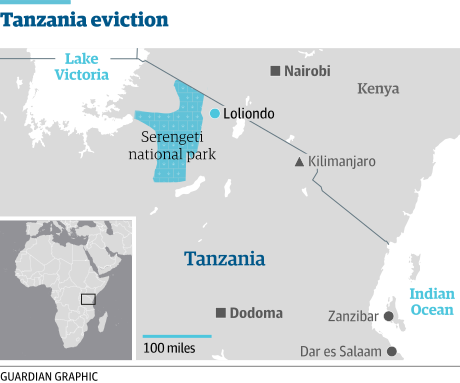
Tanzania has been accused of reneging on its promise to 40,000 Masai pastoralists by going ahead with plans to evict them and turn their ancestral land into a reserve for the royal family of Dubai to hunt big game.

Activists celebrated last year when the government said it had backed down over a proposed 1,500 sq km “wildlife corridor” bordering the Serengeti national park that would serve a commercial hunting and safari company based in the United Arab Emirates.

Now the deal appears to be back on and the Masai have been ordered to quit their traditional lands by the end of the year. Masai representatives will meet the prime minister, Mizengo Pinda, in Dodoma on Tuesday to express their anger. They insist the sale of the land would rob them of their heritage and directly or indirectly affect the livelihoods of 80,000 people. The area is crucial for grazing livestock on which the nomadic Masai depend.

Unlike last year, the government is offering compensation of 1 billion shillings (£369,350), not to be paid directly but to be channelled into socio-economic development projects. The Masai have dismissed the offer.

“I feel betrayed,” said Samwel Nangiria, co-ordinator of the local Ngonett civil society group. “One billion is very little and you cannot compare that with land. It’s inherited. Their mothers and grandmothers are buried in that land. There’s nothing you can compare with it.”

Nangiria said he believes the government never truly intended to abandon the scheme in the Loliondo district but was wary of global attention. “They had to pretend they were dropping the agenda to fool the international press.”

He said it had proved difficult to contact the Ortelo Business Corporation (OBC), a luxury safari company set up by a UAE official close to the royal family. The OBC has operated in Loliondo for more than 20 years with clients reportedly including Prince Andrew.

Activists opposing the hunting reserve have been killed by police in the past two years, according to Nangiria, who says he has received threatening calls and text messages. “For me it is dangerous on a personal level. They said: ‘We discovered you are the mastermind, you want to stop the government using the land’. Another said: ‘You have decided to shorten your life. The hands of the government are too long. Put your family ahead of the Masai.’”

Nangiria is undeterred. “I will fight for my community. I’m more energetic than I was. The Masai would like to ask the prime minister about the promise. What happened to the promise? Was it a one-year promise or forever? Perhaps he should put the promise in writing.”

This will be the last time the Masai settle for talks, he added, before pursuing other methods including a court injunction. They could also be an influential voting bloc in next year’s elections.

An international campaign against the hunting reserve was led last year by the online activism site Avaaz.org, whose Stop the Serengeti Sell-off petition attracted more than 1.7 million signatures and led to coordinated email and Twitter protests.

Alex Wilks, campaign director for Avaaz, said: “The Masai stare out from every tourism poster, but Tanzania’s government wants to kick them off their land so foreign royalty can hunt elephants there. Almost two million people around the world have backed the Masai’s call for president Jakaya Kikwete to fulfil his promise to let them stay where they’ve always lived. Treating the Masai as the great unwanted would be a disaster for Tanzania’s reputation.”

A spokesperson for Tanzania’s natural resources and tourism ministry said : “It’s the first I’ve heard of it. I’m currently out of the office and can’t comment properly.”

Filed Under: Environment Tagged With: Dubai, Masai, Mizengo Pinda, Ortelo Business Corporation, Rights, Tanzania, UAE

India and Australia agree to collaborate on rejuvenating Ganga

November 18, 2014 by Nasheman

A devotee taking a dip in the polluted waters of river Ganga in Allahabad. Photo: The Hindu

A devotee taking a dip in the polluted waters of river Ganga in Allahabad. Photo: The Hindu

Canberra/ANI: India and Australia on Tuesday announced plans to collaborate on rejuvenating the River Ganga during the visit of Prime Minister Narendra Modi here.

In a joint statement issued during Prime Minister Modi’s visit to Australia, both sides welcomed the two-way exchanges and cooperation in river basin planning under the water partnership, and a new program of joint research on agricultural water management.

Both sides also welcomed co-operation between Australian and Indian universities, and in particular, the joint PhD programmes to encourage research.

During his visit here, Prime Minister Modi renewed his invitation to Australian Prime Minister Tony Abbott to visit India again at his convenience. They also agreed that high-level visits played a key role in enhancing the strategic partnership between the two countries.

Prime Minister Modi kickstarted his day’s engagements with a visit to the War Memorial here, where he paid his tributes to those Australians who had died at war while serving their country.

He was also accompanied by his Australian counterpart Tony Abbott, where he laid a wreath in the Hall of Memory . Prime Minister Modi observed few minutes of silence at the memorial as a mark of respect and signed the visitor’s book here before he left.

Later, Prime Minister Narendra Modi was given a warm ceremonial reception here at the forecourt of the Australian Parliament and offered a gun salute.

He also inspected a guard of honour during his visit here.

During his opening statement at a joint press conference with Prime Minister Tony Abbott, Prime Minister Modi said that both nations were seeking early closure to a civil nuclear agreement that will give Australia a chance to participate in one of the world’s most safe and secure nuclear energy programmes. Besides, the two nations also decided to sign five pacts on several areas.

While addressing the joint session of the Australian Parliament, he placed Australia at the centre of India’s vision of a prosperous and regional order, at the juncture of the Indian and Pacific oceans, at a time when security and maritime navigation were valued more highly than ever before.

After addressing the Australian Parliament here, Prime Minister Modi has arrived in Melbourne where he is scheduled to address expatriate Indians at the the 161-year-old Melbourne Cricket Ground and attend two other events hosted by Prime Minister Tony Abbott, before departing for Fiji for the third leg of his three-nation, 10-day trip.

(ANI)

Filed Under: Environment, India Tagged With: Australia, Ganga, Narendra Modi, Pollution, River, Tony Abbott, Water

Four die, one injured in chemical leak at Texas plant

November 17, 2014 by Nasheman

Workers exposed to methyl mercaptan, chemical used in insecticides

Four workers died and one was injured in a chemical leak at a DuPont factory in Texas on Saturday. (Photo: Health Gauge/flickr/cc)

Four workers died and one was injured in a chemical leak at a DuPont factory in Texas on Saturday. (Photo: Health Gauge/flickr/cc)

by Nadia Prupis, Common Dreams

Four workers were killed and one injured in a chemical leak at a DuPont plant near Houston, Texas on Saturday.

A valve began leaking methyl mercaptan, a chemical used to make insecticides and fungicides, around 4am at a plant stationed in La Porte, about 20 miles east of Houston. Officials say the leak was contained by 6am, but the five employees who were in the unit at the time responded to the accident and were exposed to the chemical. The cause was not immediately known.

Methyl mercaptan is also often used to add odor to natural gas, which has no smell, for safety purposes.

According to the Houston Chronicle, among the victims were 39-year-old Robert Tisnado and his 48-year-old brother Gibby Tisnado, who had worked at the plant for six years. USA Today also wrote that the leak killed a supervisor who had been with DuPont for more than 40 years.

The Chronicle continued:

The chemical can cause severe respiratory, skin and eye irritation. It can also cause headaches, dizziness, nausea, vomiting, coma and even death. Exposure in poorly ventilated, enclosed, or low-lying areas can result in asphyxiation, according to the Agency for Toxic Substances and Disease Registry….

Antonio Areola, 50, who works at the complex for another company, said the news was extremely sad. Plant workers are haunted by the potential dangers of the job, he said.

“There’s danger in the plants, you can always feel it,” he said in Spanish.

The Associated Press reports:

The U.S. Chemical Safety Board, a federal agency that investigates chemical accidents, announced late Saturday that it was sending a seven-person team to investigate the incident.

Jeff Suggs, emergency management coordinator for La Porte, said the chemical release was not toxic for those living nearby, but that it caused a smell that’s similar to rotten eggs.

“It’s a nuisance smell in the area. It’s a smell that’s traveled quite far,” Suggs said.

The odor from the leak lingered in the area for the better part of the day and reached areas about 40 miles away, The Houston Chronicle reported.

This is not the first time in recent years that DuPont workers have been killed by overlooked safety hazards in the company’s factories around the country. As NBC News writes:

The Chemical Safety Board in 2011 found “a series of preventable safety shortcomings” at a DuPont facility in Belle, West Virginia, contributed to a 2010 phosgene gas release that killed one worker. Also in 2010, an explosion during welding at a DuPont plant outside of Buffalo, N.Y., killed one worker. The board blamed the company’s failure to monitor flammable gas levels in a storage tank before welding for that accident.

Plant manager Randall Clements said in a statement, “There are no words to fully express the loss we feel or the concern and sympathy we extend to the families of the employees and their co-workers. We are in close touch with them and providing them every measure of support and assistance at this time.”

He added that DuPont will cooperate with officials investigating the cause of the accident.

Filed Under: Environment Tagged With: Climate, DuPont, Fossil Fuels, Texas, United States, USA

Ginger cultivation in Mysuru district destroying the Environment

November 17, 2014 by Nasheman

Photo: K.K. Mustafah

Photo: K.K. Mustafah

by Vivek Cariappa

To:

The Deputy Commissioner and Dist. Magistrate, 6th Nov, 2013.
Mysore district.
Dear Madam,

Ginger cultivation in Mysore district is growing exponentially this year as the projected prices have shot up. Agricultural irrigated lands are being leased at high rates all over.

Ginger growing in Mysore is taken up by growers from Kerala, who have come across the border because Kerala state has banned many of the toxic pesticides used in Ginger cultivation; furthermore, land and labour are cheaper here making the ginger crop even more lucrative.

Out of state cultivators avail ALL the agri subsidies given to our farmers ( e.g. Finance, irrigation, power, fertilizer, sprinkler and drip irrigation equipment subsidy, etc.) and the crop is harvested and taken back to Kerala without payment of any taxes of any kind to Karnataka. As if this was not bad enough, these contract farmers leave behind a plethora of problems ranging from health issues to toxic pollution of our local water bodies, soil, air and ground water.

Irresponsible usage of huge amounts of toxic chemicals , in certain cases, have in the past resulted in severe damage and extensive losses to certified organic farms and sericulture operations. The first step for Ginger cultivation is to change the PH by adding huge quantities of lime to the soil, making the soil highly alkaline: this is permanently devastating to other crops grown thereafter.

Ginger cultivation uses huge amounts of herbicides (2-4D being one of them) Roundup in particular , pesticides and fungicides. Some of them like 2-4D and Endosulfan are banned in India, the ban is enforced in Kerala as the toxicity has had disastrous effects on the people there.

Most of these chemical residues end up in local water bodies causing unseen pollution and direct poisoning of all life forms in the water. Those that survive carry lethal concentrations of toxins that effect human and animal health in insidious and long term ways.

Last year as the water levels in ALL our water bodies was exceptionally low, the actual toxicity levels ended up dangerously high with increased Ginger cultivation. This will have widespread effects as toxicity levels increase.

As a warning, take the case of Ginger cultivation along the Kabini, Taraka and Nugu rivers and in the Paddy fields irrigated by these 3 Dams, the water, along with its toxic wash off is being supplied for drinking purposes to towns and cities as close as Nanjangud and as far as Mysore and Bangalore. Even in the villages; one village on the river side upstream pollutes water for the one’s down stream.

This year ginger cultivators are paying upto Rs.50,000 per acre per year, and have extended their operations within and around the Notified Eco-Sensitive Zone (Bandipur National Park), what effect this will have on the surrounding wildlife is left to the imagination, as no one is paying any attention at the ground level.

Further, in H.D.Kote a lot of the land being leased belongs to the Scheduled Tribe (ST) people. This makes them landless labor on their own lands. The question here is WHO WILL BE HELD ACCOUNTABLE FOR THIS HEINOUS CRIME?

I sincerely urge the Government of Karnataka, specially the administration of Mysore district to regulate Ginger cultivation carefully to ensure minimum damage to our general environment and specifically our soil, water and health – human and animal (domesticated and wild life). To not take pre-emptive action would not be just negligent but a willful destruction of our natural resources, biodiversity and the future lives of our population.

Some suggestions:

  1. All lease of land for Ginger cultivation must be legally registered with the revenue and agriculture dept. and the local APMC, only on issue of license should cultivation commence. Forest dept should restrict the areas under ginger cultivation in eco-sensitive zones and regulate the chemicals being used and its effects in terms of wash off.

  2. Banned and highly toxic pesticides must be avoided. The relevant ban must be enforced and offenders punished according to law.

  3. Ginger cultivation must be banned in eco-sensitive areas such as near forests, on the banks of lakes, rivers and dams.

  4. Being a cash crop the harvested produce should be taxed according to state norms.

  5. Ensure that license for Ginger cultivation is Not granted near Sericulture operations and silk worm rearing houses, and do not pollute certified organic farms.

  6. Enforce the Legislation for penalizing the polluter for toxic pollution resulting from Ginger cultivation.

Ginger cultivation is cheap in Karnataka as the environmental costs have not been calculated and paid for as yet, that is why contractors from Kerala have been operating here. The pollution control board needs to make regular checks on Ginger growing farms to ensure existing laws are adhered to.

Mysore is not only a tourist hot spot, the district is an Internationally recognised Bio-Diversity zone, with forests and National Parks. The ill effects of excessive use of highly toxic chemicals here will show up only in the future, as it did in Kasargod dist. of Kerala, where use of Endosulfan had permanent damage on the people and environment, by the time the authorities reacted it was too late for many.

Can we hope to be more proactive here, and learn from our neighbors mistakes ?

Looking forward to an early response from you,

Yours sincerely,

Vivek Cariappa

Halasur village, Birwal P.O. H.D.Kote taluk . 571121 . Mysore dt.

Vivek Cariappa is an organic farmer and Karnataka State award-winner

Filed Under: Environment, India Tagged With: Agriculture, Ginger, Mysore, Mysuru

  • « Previous Page
  • 1
  • …
  • 30
  • 31
  • 32
  • 33
  • Next Page »

Follow Us

  • Facebook
  • Twitter
  • YouTube

KNOW US

  • About Us
  • Corporate News
  • FAQs
  • NewsVoir
  • Newswire
  • Realtor arrested for NRI businessman’s murder in Andhra Pradesh

GET INVOLVED

  • Corporate News
  • Letters to Editor
  • NewsVoir
  • Newswire
  • Realtor arrested for NRI businessman’s murder in Andhra Pradesh
  • Submissions

PROMOTE

  • Advertise
  • Corporate News
  • Events
  • NewsVoir
  • Newswire
  • Realtor arrested for NRI businessman’s murder in Andhra Pradesh

Archives

  • February 2026 (6)
  • January 2026 (12)
  • December 2025 (6)
  • November 2025 (8)
  • October 2025 (12)
  • September 2025 (25)
  • August 2025 (46)
  • July 2025 (110)
  • June 2025 (28)
  • May 2025 (14)
  • April 2025 (50)
  • March 2025 (35)
  • February 2025 (34)
  • January 2025 (43)
  • December 2024 (83)
  • November 2024 (82)
  • October 2024 (156)
  • September 2024 (202)
  • August 2024 (165)
  • July 2024 (169)
  • June 2024 (161)
  • May 2024 (107)
  • April 2024 (104)
  • March 2024 (222)
  • February 2024 (229)
  • January 2024 (102)
  • December 2023 (142)
  • November 2023 (69)
  • October 2023 (74)
  • September 2023 (93)
  • August 2023 (118)
  • July 2023 (139)
  • June 2023 (52)
  • May 2023 (38)
  • April 2023 (48)
  • March 2023 (166)
  • February 2023 (207)
  • January 2023 (183)
  • December 2022 (165)
  • November 2022 (229)
  • October 2022 (224)
  • September 2022 (177)
  • August 2022 (155)
  • July 2022 (123)
  • June 2022 (190)
  • May 2022 (204)
  • April 2022 (310)
  • March 2022 (273)
  • February 2022 (311)
  • January 2022 (329)
  • December 2021 (296)
  • November 2021 (277)
  • October 2021 (237)
  • September 2021 (234)
  • August 2021 (221)
  • July 2021 (237)
  • June 2021 (364)
  • May 2021 (282)
  • April 2021 (278)
  • March 2021 (293)
  • February 2021 (192)
  • January 2021 (222)
  • December 2020 (170)
  • November 2020 (172)
  • October 2020 (187)
  • September 2020 (194)
  • August 2020 (61)
  • July 2020 (58)
  • June 2020 (56)
  • May 2020 (36)
  • March 2020 (48)
  • February 2020 (109)
  • January 2020 (162)
  • December 2019 (174)
  • November 2019 (120)
  • October 2019 (104)
  • September 2019 (88)
  • August 2019 (159)
  • July 2019 (122)
  • June 2019 (66)
  • May 2019 (276)
  • April 2019 (393)
  • March 2019 (477)
  • February 2019 (448)
  • January 2019 (693)
  • December 2018 (736)
  • November 2018 (570)
  • October 2018 (611)
  • September 2018 (692)
  • August 2018 (666)
  • July 2018 (468)
  • June 2018 (440)
  • May 2018 (616)
  • April 2018 (772)
  • March 2018 (338)
  • February 2018 (157)
  • January 2018 (188)
  • December 2017 (142)
  • November 2017 (122)
  • October 2017 (146)
  • September 2017 (176)
  • August 2017 (201)
  • July 2017 (222)
  • June 2017 (155)
  • May 2017 (205)
  • April 2017 (156)
  • March 2017 (178)
  • February 2017 (195)
  • January 2017 (149)
  • December 2016 (143)
  • November 2016 (169)
  • October 2016 (165)
  • September 2016 (137)
  • August 2016 (115)
  • July 2016 (116)
  • June 2016 (124)
  • May 2016 (170)
  • April 2016 (150)
  • March 2016 (199)
  • February 2016 (201)
  • January 2016 (216)
  • December 2015 (210)
  • November 2015 (174)
  • October 2015 (281)
  • September 2015 (241)
  • August 2015 (250)
  • July 2015 (188)
  • June 2015 (216)
  • May 2015 (281)
  • April 2015 (306)
  • March 2015 (296)
  • February 2015 (280)
  • January 2015 (245)
  • December 2014 (286)
  • November 2014 (254)
  • October 2014 (185)
  • September 2014 (98)
  • August 2014 (7)

Copyright © 2026 · News Pro Theme on Genesis Framework · WordPress · Log in